Intervention: Genetic Pollution, Smart Breeding and the Risks of Unregulated Transgenesis.

Article PhotoAs a kid in the 70's, I remember walking the shores of Lake Michigan and dodging the rotting piles of dead fish covered in maggots.

These small, silver fish, called alewives, grew in unchecked mega-pods because of the lack of a top predator in the lakes. Lake trout were essentially wiped out around the same time by overfishing and the invasion of the exotic, rapacious sea lamprey. For a time, alewives, which often exhibit seasonal die offs, washed up in putrid layers on the shorelines of the Great Lakes.

There was (and is) a crazy cascade of invasive species that were intentionally introduced to solve the problem. Each intentional introduction of a foreign species creates a new ecological issue that permanently altered the ecology of the Great Lakes. The most recent intruder? Massive Asian carp that can grow to be 80 to 100 pounds. They're ravenous eaters, consuming up to 40 percent of their own body weight in plankton each day. And they're bullies, pushing out weaker, native species. (Listen to NPR story.)

So... the prospect of having genetically modified organisms and micro-organisms invade my personal ecology fills me with dread. Even if measures of accountability are imposed, once the damage is done, there is no point of return.
The latest book by science writer, Denise Caruso, details the threats of introducing new organisms--whether on the nano, the micro and the macro-levels--into the fragile ecology of our planet. Ecological catastrophes that would dwarf the breech of New Orleans' levees.

These potential disasters would, in the words of Caruso, "create stewardship challenges for generations into the future that are already far beyond our present scientific knowledge or capabilities."

From Worldchanging:

Denise Caruso holds a somewhat legendary status among tech journalists. A columnist for the NY Times (her old Information Industries column was a must-read for years, while her new column Re:Framing just kicked off on a bang with a piece titled Someone (Other Than You) May Own Your Genes) and founder of the Hybrid Vigor Institute (an NGO dedicated to facilitating interdisciplinary and collaborative approaches to scientific problem solving), it's not going too far to say that Caruso's work has helped shape our society's thinking about the future of science.

That future may be riskier than we like to think. In her new book, Intervention: Confronting the Real Risks of Genetic Engineering and Life on a Biotech Planet, Caruso lays out in chilling detail exactly why even (perhaps especially) those of us who are strong supporters of science and innovation ought to be extremely concerned about the unintended consequences of contemporary biotechnological industrial research.
peterdurand

Peter Durand is an artist, educator & visual facilitator based in Houston, Texas.

He is the founder of Alphachimp LLC, a visual facilitation company that helps clients understand and communicate complex systems visually. He is a leader in graphic facilitation and a professor at Northwestern University Pritzker School of Law.

Damn Cool Pics

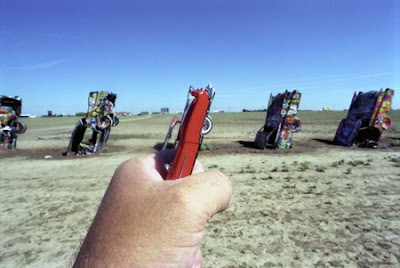
Lots more fun photos like this. It's like the old "I'm crushing your head" skit from Kids in the Hall. 'Cept different.

peterdurand

Peter Durand is an artist, educator & visual facilitator based in Houston, Texas.

He is the founder of Alphachimp LLC, a visual facilitation company that helps clients understand and communicate complex systems visually. He is a leader in graphic facilitation and a professor at Northwestern University Pritzker School of Law.

Duct Tape Wallet Kit

From Josh Rubin's Cool Hunting
by Ami Kealoha, 16 February 2007 duct-tape-wallet-kit.jpg

It doesn't get anymore DIY than a duct tape wallet. But simple as they may seem, there's a right way and a wrong way. MyDuctbills Duct Tape Wallet Kits comes with step-by-step instructions written by the pros behind dbclay, the Portland-based company that makes quality duct and (more recently) gaffers tape wallets.

For $20, you get a booklet and all the materials you'll need, including three strips of colored duct tape for decoration.

Pick one up from myDuctbills. If you'd rather leave the crafting to the experts, you can still get a ductbill (the original duct tape wallet that preceded dbclay's gaffers tape wallets) here.

peterdurand

Peter Durand is an artist, educator & visual facilitator based in Houston, Texas.

He is the founder of Alphachimp LLC, a visual facilitation company that helps clients understand and communicate complex systems visually. He is a leader in graphic facilitation and a professor at Northwestern University Pritzker School of Law.

The Monastic Help Desk

After a year of working on MissingLink with GradientLabs, and trying to introduce it to the larger graphics and facilitation world, I identify with this Old School Brother of the Monastic Help Desk.

[Thanks to Mark Frisse]

peterdurand

Peter Durand is an artist, educator & visual facilitator based in Houston, Texas.

He is the founder of Alphachimp LLC, a visual facilitation company that helps clients understand and communicate complex systems visually. He is a leader in graphic facilitation and a professor at Northwestern University Pritzker School of Law.

The Biggest Valentine: Salvation Mountain


Salvation Mountain, originally uploaded by Eye-Appeal.

This pretty much sums up what I plan on doing for my retirement: Making a big, crazy colorful mountain in the middle of nowhere.

Salvation Mountain was created by Leonard Knight, if you would like to learn more go to www.roadsideamerica.com/.

In the mid-1980s, Leonard Knight, with the aim of spreading God's word, began building a hot air balloon from bed sheets. In bold letters, he painted “God is Love” on the balloon’s face. He planned to float it high above the earth where all could see its message. Attempts to get the balloon airborne failed, however, and Knight was left in the Southern California desert with a pile of rotting linen. It was this aborted mission that led Knight to his eventual calling, the 20-year construction of Salvation Mountain. Today, Knight’s mountain is a colorful array on a neutral canvas. Built of adobe and covered in over 100,000 gallons of donated paint, Salvation Mountain forms part of the cultural landscape.

See more at PBS Travelogue.

peterdurand

Peter Durand is an artist, educator & visual facilitator based in Houston, Texas.

He is the founder of Alphachimp LLC, a visual facilitation company that helps clients understand and communicate complex systems visually. He is a leader in graphic facilitation and a professor at Northwestern University Pritzker School of Law.

Chimps in Thailand


Sita Magnuson sends us greetings (and some stellar pics!) from her scribing gig in Thailand.

Check out some of her fun and exotic photos.

FLICKR SET: http://flickr.com/photos/hoodsie/sets/72157594522832680/
SLIDESHOW: http://flickr.com/photos/hoodsie/sets/72157594522832680/show/

peterdurand

Peter Durand is an artist, educator & visual facilitator based in Houston, Texas.

He is the founder of Alphachimp LLC, a visual facilitation company that helps clients understand and communicate complex systems visually. He is a leader in graphic facilitation and a professor at Northwestern University Pritzker School of Law.

Digital Anthropology's Web 2.0

As graphic facilitators, the tools that allow us to synthesize ideas into images--whether static or dynamic--are expanding exponentially.

In this video thought piece hosted on YouTube, Kansas State Anthropology professor Michael Welsch uses the simple, cheap digital tools at hand to weave an engaging narrative of the birth of Web 2.0.

[ via Jarrell McAlister ]

Welsch expresses the miracle of that birth, writing: "We're teaching the machine, and the machine is us. Time to rethink the world. The network is the machine; the machine is us."Digital Ethnography is a working group of Kansas State University students and faculty

dedicated to exploring and extending the possibilities of digital
ethnography.

He literally draws the path of communication evolution from handwritten, linear text to non-linear hypertext, HTML, XML, RSS and mash-ups.This is the most elegant and engaging description of where media is today. And to think, he did it without using a single bullet point!Currently Wesch is launching the Digital Ethnography working group

at Kansas State University to examine the impacts of digital technology
on human interaction.

The first outcome of this work was a short video called "Web 2.0 ... The Machine is Us/ing Us." The video was released on YouTube on January 31st 2007 and quickly became the most popular video in the blogosphere.

peterdurand

Peter Durand is an artist, educator & visual facilitator based in Houston, Texas.

He is the founder of Alphachimp LLC, a visual facilitation company that helps clients understand and communicate complex systems visually. He is a leader in graphic facilitation and a professor at Northwestern University Pritzker School of Law.

The Future Perfect Sense

My New Year's resolution is this: To be more observant.

Recently, my family downshifted from living in a city neighborhood behind two national sports team stadiums (oh, the fireworks--they never ceased!) to living in a little house on a 23-acre farm in rural Tennessee.

Now, I find myself walking and listening again in a way that had been degraded by the rhythm of taxi-airport-work-airport-taxi-home. This morning as I walked along a muddy gravel road, instead of the dull thuds of a souped up Lincoln Navigator thumping Hip Hop beats, I heard what turned out to be two teenage boys galloping up the ridge on horseback.

Jan Chip is an extreme observer. As Principal Researcher in the Mobile HCI Group at Nokia Research, Jan divides his time between running user studies and developing new applications, services and products. As he writes, "If I do my job right, you'll be using the product 3 to 15 years from now."
In the majority of culture that his team studied, three objects were considered essential across all participants, cultures and genders were keys, money and mobile phone.

(Read Jan's essay Why We Carry Mobile Phones).
But his job (and personal obsession) is observing The Now through the eyes of an ethnologist. Whether beer bottles discarded at Tibetan holy sites, playfully designed rat traps in Asian airports, or the menu of a Chinese "greasy spoon" (rats again!), or international rubbish collection norms, Jan's eye catches the easy-to-miss details and strings them into deep cultural patterns.

His blog, Future Perfect, is inspired by the traveling research required by his day job, but Jan admits, "The material that you see on this site is what I do in my spare time - the stuff that inspires or challenges me, helps me understand how the future might turn out."

peterdurand

Peter Durand is an artist, educator & visual facilitator based in Houston, Texas.

He is the founder of Alphachimp LLC, a visual facilitation company that helps clients understand and communicate complex systems visually. He is a leader in graphic facilitation and a professor at Northwestern University Pritzker School of Law.

Make Mag's EduVideos

Make Magazine brings you weekend projects of stuff you can make at home.

I found this too late for the holidays, but this video demonstrates three techniques for creating small holiday cards: aluminum foil, woodblock prints and writing with light!

[via Blip.tv]

peterdurand

Peter Durand is an artist, educator & visual facilitator based in Houston, Texas.

He is the founder of Alphachimp LLC, a visual facilitation company that helps clients understand and communicate complex systems visually. He is a leader in graphic facilitation and a professor at Northwestern University Pritzker School of Law.