Crowley Caught a Wild Swarm of Bees

Alphachimp graphic facilitator Steph Crowley is now the proud mamma of two families of bee colonies. We received this email from here about her adventures in bee keeping:

Hello fellow nature geeks! : )

If you're interested, I caught a wild swarm of bees not too long ago that had set up a temporary residence in our front walkway to our house. I was happy to see them, but the neighbors were not. A swarm of bees is a big cluster of bees looking for a new home, with their queen hiding out in the middle of the cluster.

They're very gentle at this point because they're homeless and have nothing to protect. So I caught them and gave them a proper home in a new hive in the backyard. Anyhow, if you want to see photos and a video I shot while hiving the swarm of bees, feel free to take a look at my bee photo webpage!

Enjoy!

peterdurand

Peter Durand is an artist, educator & visual facilitator based in Houston, Texas.

He is the founder of Alphachimp LLC, a visual facilitation company that helps clients understand and communicate complex systems visually. He is a leader in graphic facilitation and a professor at Northwestern University Pritzker School of Law.

Malcolm Gladwell: Lessons of Psychology and Sociology

From PopTech 2004, Malcolm Gladwell takes the lessons of psychology and sociology and applies them to business in ways we’ve never thought of before. Here, he deep-dives into the world of office chair invention and soft drink taste tests to answer the question, “Can we believe what people tell us?”

See more Pop!Casts >>

peterdurand

Peter Durand is an artist, educator & visual facilitator based in Houston, Texas.

He is the founder of Alphachimp LLC, a visual facilitation company that helps clients understand and communicate complex systems visually. He is a leader in graphic facilitation and a professor at Northwestern University Pritzker School of Law.

Global X — Social Edge - David Bornstein - How to Change the World

David BornsteinFrom the Skoll Foundation's website dedicated to Social Entrepreneurs, SocialEdge:

Watch leading social entrepreneurs as they tell stories that had a significant impact on their lives. They also describe how they see the world in 2017. These interviews were shot at the 2007 Skoll World Forum at Oxford and are quite short (3 to 7 minutes).

David Bornstein, author of How to Change the World, told Global X what happened when he was a young journalist and he first met Muhammad Yunus in Bangladesh.

He also talks about his aunt Suzan, who taught him to climb the fence when necessary: "The world is a playground, and one shouldn't follow the rules at all times."

peterdurand

Peter Durand is an artist, educator & visual facilitator based in Houston, Texas.

He is the founder of Alphachimp LLC, a visual facilitation company that helps clients understand and communicate complex systems visually. He is a leader in graphic facilitation and a professor at Northwestern University Pritzker School of Law.

In Tennessee, Goats Eat the ‘Vine That Ate the South’ - New York Times

by By THEO EMERY | Published: June 5, 2007


photo: Josh Anderson for The New York Times

CHATTANOOGA, Tenn. — Summer is settling onto Missionary Ridge overlooking this southeast Tennessee city. Swallows glide on the warm breeze rustling the hackberry trees, kudzu vines sprout along the hillside and the goats are back at work.

Chattanooga’s goats have become unofficial city mascots since the Public Works Department decided last year to let them roam a city-owned section of the ridge to nibble the kudzu, the fast-growing vine that throttles the Southern landscape. MORE>>

peterdurand

Peter Durand is an artist, educator & visual facilitator based in Houston, Texas.

He is the founder of Alphachimp LLC, a visual facilitation company that helps clients understand and communicate complex systems visually. He is a leader in graphic facilitation and a professor at Northwestern University Pritzker School of Law.

Takashi Horisaki: A Latex Replica of a NOLA Shotgun House, Post-Katrina

WorldChanging: Tools, Models and Ideas for Building a Bright Green Future: Art for Our Sake
by Sarah Rich | June 10, 2007 7:43 PM

When artist Takashi Horisaki left his native Japan, he moved to New Orleans to spend his first three years in America earning an BFA at Loyola University. He left before Katrina ravaged the area, and returned in 2006 to discover 'how seriously those of us living outside of the victimized area fail to grasp the reality of the tragedy suffered by New Orleans and the lethargic pace of recovery.' So he decided to help outsiders get a better perspective by creating a sculptural replica of a condemned house in the Lower 9th Ward.
This is a continuation of a series Horisaki calls Social Dress (this one being called Social Dress New Orleans -- 730 Days "

peterdurand

Peter Durand is an artist, educator & visual facilitator based in Houston, Texas.

He is the founder of Alphachimp LLC, a visual facilitation company that helps clients understand and communicate complex systems visually. He is a leader in graphic facilitation and a professor at Northwestern University Pritzker School of Law.

Web Design on the Brain

Regardless of the debate on evolution reverberating still in America, the fact is, our brains were built for one purpose--survival in the natural world.

Have a look at this picture.. Where are the lions?

The brain is designed to take in massive amounts of information, concentrate on details, discriminate what is important, focus on a goal, design a plan and send out commands for action.

I was pleased to read that even in the eyeball-and-index-finger world of the web, that the same mental process is still taking place! More to the point--designers need to understand how the brain works in order to build navigation systems and information hierarchies that enable (rather than frustrate) our paleolithic instinct to hunter and gather.

According to Ben Hunt of Scratchmedia, a small consulting business based in the UK: "One way to think about designing for web users is to consider what the brain is good at, and to design to take the best advantage of those strengths."

From a post titled The Brain's Strengths on the blog, Web Design from Scratch:

Matching shapes

The minds of higher order animals are highly skilled at recognising things by their shape, or outline. We have an amazing ability to associate shapes with their meanings very quickly. This can be helpful for spotting your quarry when hunting in thick vegetation or in poor light. We're more likely to use this skill when associating the shape of an icon with 'I can make a printed version of this page if I move my mouse and click on that', or to decide to ignore a banner ad based on its shape.

Seeing patterns

Our brains are great at spotting associations between objects, based on similarities, alignment and grouping. This is helpful for working out where to move in order to separate an animal from its herd, or for telling which strangers belong to which tribes. Today, we're more likely to use this ability to find the navigation on a new site, or to tell at a glance how many unopened emails we have.

Focusing on the important; ignoring the unimportant

When we match shapes and patterns, we quickly sort what to focus on from what to ignore. This is a talent we share with all natural predators. If the brain loses its ability to filter out noise, we go mad. We use this skill every time we look at a web page, by scanning for clues that help us get nearer our goal.

High-speed problem solving

When faced with new problems, we're great at working out new ways of addressing them, even by abstracting patterns that have worked for different problems. Our minds are tuned for computing available information, and quickly choosing a most likely solution. (This capacity is one of the things that distinguishes the intelligence of apes from monkeys.)

peterdurand

Peter Durand is an artist, educator & visual facilitator based in Houston, Texas.

He is the founder of Alphachimp LLC, a visual facilitation company that helps clients understand and communicate complex systems visually. He is a leader in graphic facilitation and a professor at Northwestern University Pritzker School of Law.

Stasi Chic

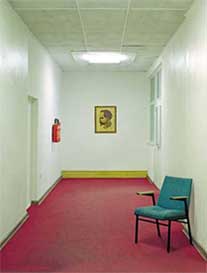
When I lived and traveled in Eastern Europe after the Berlin Wall came down, I was captivated by the interior design of utilitarian minimalism that pervaded the former East Bloc.

Whether in Slovakia or Bulgaria or Moscow, there was something so ubiquitous and clean about the architecture of dictatorship.

From We Make Money Not Art:

Daniel & Geo Fuchs have documented the architectural legacy left by the former GDR’s Ministry for State Security (Stasi), the main security and intelligence organization of the German Democratic Republic (East Germany).

0aindastaz2.jpg 0stazii8.jpg

The Stasi had nearly 90,000 official workers and 170,000 unofficial collaborators in a country with a population of 16 million. The organization was dissolved 18 years later, yet some of these sites have remained practically as they were.

The photographs show the rooms that the Stasi used to interrogate prisoners; prison cells for political prisoners; the offices of the minister for State Security; bunkers; and the files stored by the Stasi Documentation Office in Berlin - endless stacks of protocols generated by control and espionage, division and corruption – witnesses of the total control of a regime that clung to power for over 40 years.

The images are on show at La Virreina in Barcelona until July 1. Images.

peterdurand

Peter Durand is an artist, educator & visual facilitator based in Houston, Texas.

He is the founder of Alphachimp LLC, a visual facilitation company that helps clients understand and communicate complex systems visually. He is a leader in graphic facilitation and a professor at Northwestern University Pritzker School of Law.

The NARC in Your Sneakers

From Kevin Kelly's Cool Tools:

Spy Chips

Be(a)ware of how your belongings could track you

spychips-sm.jpg

This book will make you look at every store-bought item you own or debate owning with a curious skepticism that -- after reading the book -- won't seem too unwarranted. It was published two years ago (a cheap paperback came out in the fall), but if you've yet to explore the fascinating, potentially paranoia-inducing, world of RFID and you want the cautionary, consumer-advocate perspective about the Radio Frequency Identification tracking being proposed -- and used! -- by certain companies (for instance, Gillette, Procter & Gamble and Wal-Mart), I highly recommend this one. I've been meaning to read it for a while and so some of the stories were familiar (i.e. the nightclub in Spain that chips its members), but there were plenty of bits that were new and interesting to me (i.e. all the patents IBM has applied for, including one for an RFID-enabled closet). Katherine Albrecht and Liz McIntyre take a pretty sensationalist tone -- "Big Brother" is mentioned a number of times -- but the scope of the research is impressive (lots of endnotes) and their insight into how this tech could be abused is thought provoking.

-- Steven Leckart

Spy Chips: How Major Corporations and Government Plan to Track Your Every Purchase and Watch Your Every Move
Katherine Albrecht & Liz McIntyre
2006 (paperback), 304 pages
$11
Available from Amazon

peterdurand

Peter Durand is an artist, educator & visual facilitator based in Houston, Texas.

He is the founder of Alphachimp LLC, a visual facilitation company that helps clients understand and communicate complex systems visually. He is a leader in graphic facilitation and a professor at Northwestern University Pritzker School of Law.

PowerPoints the Matter: US Secretary of Evil

As a person who attends more meetings than I can stick a shake at, I sure am sorry I missed this one. It seems like some vital new updates to national policy were delivered in rare style.

From that time-honored lighthouse to truth, The Onion:

WASHINGTON, DC—In the latest in a long series of ominous public pronouncements, the Department of Evil released a statement Monday demanding that all residents of the United States must die.

Dread Secretary of Evil Hammond S. Reynolds told reporters that they, too, must die.

"Yes, all must die," Dread Secretary of Evil Hammond S. Reynolds said during a press conference in Room 1228 of Washington's Robert C. Weaver Federal Building. "There shall soon come an accounting in which all will fall before the Grim Reaper as wheat in winter, as lambs under the knife. Soon all necks will feel the steely bite of our soul- thirsting axe, wielded by the unforgiving iron hand of the Department of Evil. Thus spake I, Dread Secretary Reynolds."

peterdurand

Peter Durand is an artist, educator & visual facilitator based in Houston, Texas.

He is the founder of Alphachimp LLC, a visual facilitation company that helps clients understand and communicate complex systems visually. He is a leader in graphic facilitation and a professor at Northwestern University Pritzker School of Law.