MUTO: An Ambiguous Animation Painted on Public Walls

Imagine creating a 7 minute short animated film using hand drawn black-and-white line drawings. At 12 frames per second, you would have to create 5040 individual drawings.

Now image creating the same number of sequential images but with spray paint on public buildings. That is what this trippy video created in Argentina presents. It is hypnotizing. (Thanks to Matt Andrews)

clipped from blublu.org

MUTO a wall-painted animation by BLU from blu on Vimeo.

peterdurand

Peter Durand is an artist, educator & visual facilitator based in Houston, Texas.

He is the founder of Alphachimp LLC, a visual facilitation company that helps clients understand and communicate complex systems visually. He is a leader in graphic facilitation and a professor at Northwestern University Pritzker School of Law.

Meeting on the Right Side of the Brain

We've been preaching it for years, but I guess it is now news:

Creative work environments improve creative thinking!

Congrats to Leslie Marquard and Catalyst Ranch on leading the piece. Thanks for bringing "right-brained thinking" to a "left-brained" world. (Actually, working in creative environments and using multiple learning modalities inspires whole-brain thinking.)
clipped from www.nytimes.com

Steve Kagan for The New York Times
By ELAINE GLUSAC | Published: April 30, 2008

WHEN Leslie Marquard, an executive coach, holds strategy sessions for consulting firms or university administrators, she ushers her buttoned-up clientele into rooms full of Pogo sticks, ethnic art, hammocks, vintage furniture and a pillow “harem.”

“They are surprised and also endeared by it,” said Ms. Marquard, a co-founder of Marble Leadership Partners in Chicago. The “it” she referred to is Catalyst Ranch, an independent alternative meeting space in a former sausage factory near the Loop in Chicago. “They’ll say, ‘That table looks just like one I grew up with.’ It subconsciously releases the mind.”


blog it

peterdurand

Peter Durand is an artist, educator & visual facilitator based in Houston, Texas.

He is the founder of Alphachimp LLC, a visual facilitation company that helps clients understand and communicate complex systems visually. He is a leader in graphic facilitation and a professor at Northwestern University Pritzker School of Law.

Design and the Elastic Mind

Photovoltaic cells grown like ivy, electricity cultivated from your corpse, computer-aided oragami, a pheronome dating agency apparatus,... these are some of the beautiful and bizarre designer objects on display at MOMA.

In the words of the senior curator, Paola Antonelli: "Designers they know that their role is to enable revolution. They are constructive by definition."

clipped from www.coolhunting.com

To document MoMA's wonderful, monumental exhibit spanning design, science and technology, "Design and the Elastic Mind," we enlisted the help of the show's esteemed curator, Paola Antonelli. Paola speaks in detail about several of the exhibits, including "The Afterlife," a system for turning corpses into batteries, robots that act as personal climatizers and DNA origami. She also weighs in on her curatorial approach, addressing the role of the designer, her mission to shift public perception of design and how design revolutionizes our lives.

As always, but especially in this case, we hope CH inspires you to experience this show firsthand. It's up through May 2008, see details below.

If you absolutely can't make it in person, the website, designed by the renowned
Yugo Nakamura
, is full of information organized into an extremely pleasing UI and the book (available online from the MoMA store) is a must-have resource for designers, educators and the curious.


blog it

peterdurand

Peter Durand is an artist, educator & visual facilitator based in Houston, Texas.

He is the founder of Alphachimp LLC, a visual facilitation company that helps clients understand and communicate complex systems visually. He is a leader in graphic facilitation and a professor at Northwestern University Pritzker School of Law.

Quieting the Demons and Giving Art a Voice

Two new books highlight the writing of authors with mental illness.
clipped from www.nytimes.com
In Madness: A Bipolar Life, Marya Hornbacher brings to the discussion more than the usual pairing of disturbed brain and talented mind. Her talent has created a third self, an appealing, rueful narrator (read excerpt) who can look back on three decades of manic-depressive illness, much of it untreated, and spin a story that is almost impossible to put down. In the same way that the psychiatrist Kay Redfield Jamison experienced, recorded and then analyzed her own case in the 1995 classic “An Unquiet Mind,” Ms. Hornbacher provides the perfect trifecta of perspectives.

More reflections on the same subject can be found in Poets on Prozac: Mental Illness, Treatment, and the Creative Process. This collection of essays solicited from published poets with psychiatric illness. Most of the 16 contributors are decades older than Ms. Hornbacher, but while they may lack her vivid prose style, they do supply a long-term perspective on the terrain.
With problems ranging from mild unmedicated depression to schizophrenia treated with an unorthodox megavitamin technique, these writers also focus on trapping the words — and all agree that the sick brain often spells catastrophe for the creative mind. While mental illness may form a part of the creative cycle, if untreated its own cycles invariably take over. “Depression steals the voice,” writes Liza Porter. “Silence breeds depression. Depression breeds silence.”


blog it

peterdurand

Peter Durand is an artist, educator & visual facilitator based in Houston, Texas.

He is the founder of Alphachimp LLC, a visual facilitation company that helps clients understand and communicate complex systems visually. He is a leader in graphic facilitation and a professor at Northwestern University Pritzker School of Law.

Once Again, Moustache Madness sweeps Germany

What makes this video from Reuters even more unnerving is the absolute stoic seriousness of the participants in this contest.

(I also enjoy the information graphic consulted by the judges. Sort of like a menu of mustaches!)

clipped from www.reuters.com

German beard and moustache championship draws more than 100 men from various countries to compete for most extravagant look.

Organized by the Eastern Bavarian Beard and Moustache Club, the event drew competitors from many countries including Britain, Germany and Switzerland.

peterdurand

Peter Durand is an artist, educator & visual facilitator based in Houston, Texas.

He is the founder of Alphachimp LLC, a visual facilitation company that helps clients understand and communicate complex systems visually. He is a leader in graphic facilitation and a professor at Northwestern University Pritzker School of Law.

From Idea Sandbox: The Prioritizer

Idea Sandbox Helps You Be Remarkable
Prioritizer is the way to prioritize three or more items! Get yourself in order. If you like Prioritizer, you may also enjoy using Big Dig problem solving tool, also from Idea Sandbox.

I have wasted so many man hours (or monkeyman hours!) researching GTD and Zen Habits and Flylady techniques. In the end. All I need to know is what to do next, based on what is most important.

The pulsing brain behind Idea Sandbox, Paul Williams, has provided another simple on-line tool that helps get me set to tackle my to-do list... in order of priority!

(Believe me, that is a huge change!)

peterdurand

Peter Durand is an artist, educator & visual facilitator based in Houston, Texas.

He is the founder of Alphachimp LLC, a visual facilitation company that helps clients understand and communicate complex systems visually. He is a leader in graphic facilitation and a professor at Northwestern University Pritzker School of Law.

The Point: Web 2.0 tool for creating your own change

Thepoint

The Point brings together problems, people, and the pressure of collective action. The site allows users to create campaigns and encourage other people to join anonymously.

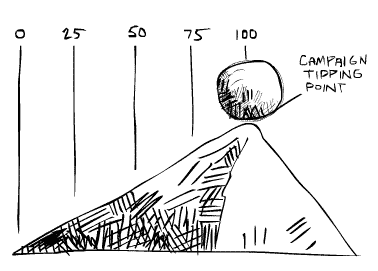
Using the principles of Gladwell's Tipping Point, once the number of members reaches a certain critical mass (10, 50, 2000) and action is triggered: a sale, a press release, a protest.

Campaigns are tools for people to organize a group action that occurs only when enough people join to make participation worthwhile. Campaigns can be used for any situation where people want safety in numbers, from planning a party to boycotting a corporation to saving chickens.

Check out the simple, clever animations used to demonstrate the types of people, the problems they want to tackle, and the resulting campaigns--that can use The Point to catalyze change.

clipped from www.thepoint.com

Make Something Happen.

Thepointpeople

The Point is a platform for group action, helping you make things happen that you couldn't accomplish alone.

peterdurand

Peter Durand is an artist, educator & visual facilitator based in Houston, Texas.

He is the founder of Alphachimp LLC, a visual facilitation company that helps clients understand and communicate complex systems visually. He is a leader in graphic facilitation and a professor at Northwestern University Pritzker School of Law.

Pain as an Art Form

The tortured artist is as predictable a stereotype as the jolly fat man. All art is a form of communication, and most works substitute one sense (sight, sound, taste) for another.

The Pain Exhibit covers just about the entire landscape of life and, consequently, of pain: fear, love, torture, loss of faith, acceptance, hope and transformation.

Some of the images from the exhibit depict the physical side of pain; others convey the emotional challenges of chronic pain.

INSERT DESCRIPTION
Selections from the Pain Exhibit. To see a slide show, click here.

Pain doesn’t show up on a body scan and can’t be measured in a test. As a result, many chronic pain sufferers turn to art, opting to paint, draw or sculpt images in an effort to depict their pain.

One of the most famous pain artists is Mexican painter Frida Kahlo, whose work, now on exhibit at the Philadelphia Museum of Art, is imbued with the lifelong suffering she experienced after being impaled during a trolley accident as a teenager. Her injuries left her spine and pelvis shattered, resulting in multiple operations and miscarriages, and she often depicted her suffering on canvas in stark, disturbing and even bloody images.

INSERT DESCRIPTION
The Broken Column, by Frida Kahlo (Banco de México Diego Rivera and Frida Kahlo Museums Trust)

“People don’t believe what they can’t see,'’ Mr. Collen said. “But they see a piece of art an individual created about their pain and everything changes.'’

blog it

peterdurand

Peter Durand is an artist, educator & visual facilitator based in Houston, Texas.

He is the founder of Alphachimp LLC, a visual facilitation company that helps clients understand and communicate complex systems visually. He is a leader in graphic facilitation and a professor at Northwestern University Pritzker School of Law.

Your Boss Is a Monkey


This Fast Company article was inspired by a woman who studied animal trainers who could teach whales not to spit, dolphins to jump through hoops, and monkeys to ride skateboards. She asked herself: "What if I used those techniques on my husband?!"

The Heath brothers, authors of Made to Stick: Why Some Ideas Survive and Others Die apply this approach to another irritable mammal: your boss.

Their suggestion: "Maybe you should start treating him or her like an exotic animal."

clipped from www.fastcompany.com

Exotic-animal trainers need a great poker face. Let's say you're a trainer, and one day, a beluga whale spits a mouthful of cold water at you. Your first instinct will be to shriek or jump or curse, but any reaction will probably reinforce the spitting. If you react, that whale will own you, and you'll be a Spit Bull's-eye for the rest of your life. Instead, you must ignore it and appear unfazed, expressionless -- a training technique called "least-reinforcing scenario," or LRS.

Animal trainers have a saying: It's never the animal's fault. That means you can't blame an animal for something the trainer has failed to do. Similarly, you can't fault your boss's bad behavior when you've failed to use some of the primary principles of training. Rule one, as we've seen with the yeller, is to ignore bad behavior.

If you've ever grudgingly tossed your dog a french fry after 15 minutes of begging, you've taught the dog a lesson -- persistence pays. So what are you inadvertently teaching your boss?

blog it

peterdurand

Peter Durand is an artist, educator & visual facilitator based in Houston, Texas.

He is the founder of Alphachimp LLC, a visual facilitation company that helps clients understand and communicate complex systems visually. He is a leader in graphic facilitation and a professor at Northwestern University Pritzker School of Law.