Artnatomy (or How to Make Funny Faces)

My parents used to politely request that I refrain from making funny faces at the dinner table. I never was able to, and even now I can't keep a straight face in front of any camera, mirror, store window or mud puddle.

After all, faces are incredible.

To see the insane tapestry of muscles lacing the bones of our skull, check out Artnatomy, a collaboration between two professors from Spain. This Flash animation shows the mechanics of every twitch, tick, wink and knowing look that our faces can muster.

[Thanks to Nellie Durand]

From the creators:

The primary goal is to provide the student and those interested, a convenient refernce tool, facilitating familiarity and experiemntation with the underlying anatomical structures using correct biomechanical representation of the different facial expressions.

Victoria Contreras Flores studied Fine Arts in Spain at the Polytechnic University of Valencia, and is a teacher of figure drawing, illustration and digital tools. She is also founding partner of DES.AR.ME (Artistics Development of Media).

Carlos Plasencia Climent is the author of many texts describing the muscles of the face and facial expression. He is a professor of morphologic anatomy in the Fine Arts Faculty at the Polytechnic University of Valencia.

peterdurand

Peter Durand is an artist, educator & visual facilitator based in Houston, Texas.

He is the founder of Alphachimp LLC, a visual facilitation company that helps clients understand and communicate complex systems visually. He is a leader in graphic facilitation and a professor at Northwestern University Pritzker School of Law.

Barrel of Monkeys

[Thanks to Jarrell McAlister]

Barrel of Monkeys (BOM) is a Chicago-based ensemble of actor/educators that creates an alternative learning environment in which children share their personal voices and celebrate the power of their imaginations.

BOM accomplishes this through creative writing workshops and in-school performances of children's stories. BOM also engages the broader community in support of the visions of children through public performances of their work (see video).


Barrel of Monkeys (BOM) is an ensemble of actors and educators that creates an alternative learning environment in which children share their personal voices and celebrate the power of their imaginations. BOM accomplishes this through creative writing workshops and in-school performances of children's stories from said workshops. BOM also engages the broader community in the visions of children though public performances of their work.

Learn more >>

peterdurand

Peter Durand is an artist, educator & visual facilitator based in Houston, Texas.

He is the founder of Alphachimp LLC, a visual facilitation company that helps clients understand and communicate complex systems visually. He is a leader in graphic facilitation and a professor at Northwestern University Pritzker School of Law.

Wacky Packages of the Global Economy

Tom Vanderbilt, a New York City-based writer on architecture, design, technology, science and other topics, was strolling down on side street off the Djemma al Fna square in Marrakech, when this design mutation caught his eye.

The packages of "Crust" toothpaste instantly triggered boyhood memories of the sardonic illustration of real product designs, Wacky Packages.

He details his experience on Design Observer:

But questions swirled like dust: Why had this one-time Wacky Package, decades after the fact, landed in North Africa (I would later learn you can buy Crust in Libya as well) as a knockoff? Who was behind this strange bit of design deception, and, more importantly, did they not realize the negative connotations of their word choice? (Of course, Crist might not play so well in those markets either.) And yet perhaps that negative connotation was lost anyway on consumers for whom English would be a second language, if that — but in that case, what connotation was there to begin with?

Were the bootleggers playing off of a commanding market share of Crest Toothpaste in the Moroccan market? Had Procter and Gamble succeeded in imbuing Crest with sufficient prestige and glamour to necessitate an imitator?

I was standing at the funhouse-mirror-lined vortices of the global economy: The Knockoff Zone.

peterdurand

Peter Durand is an artist, educator & visual facilitator based in Houston, Texas.

He is the founder of Alphachimp LLC, a visual facilitation company that helps clients understand and communicate complex systems visually. He is a leader in graphic facilitation and a professor at Northwestern University Pritzker School of Law.

Ivan Marovic: Breakaway Games

It is human nature to resist change. So one might ask, how could a group hope to bring about major social, economic, political, religious or cultural changes in a non-violent way, or know if the means one chooses would provide the desired result, or create new problems? In this session, Ivan Marovic talks about a new game that helps address these issues. Through his experiences in the Otpor (resistance), Ivan Marovic was key in shaping a new online game where people can play out real world scenarios and strategies in a virtual world.

He began working on this new game, called 'A Force More Powerful,' a little over two years prior to this session. Within this virtual world, players manage every aspect of their movement, resources and characters to apply real world principles of human nature, conflict, the process of resistance, and ultimate successful resolution.

Through 'A Force More Powerful,' players can practice strategic scenarios such as battling corruption and social problems such as pain and suffrage, discrimination against women, or even to overthrow a dictatorship. Players can also use the Scenario Editor to create their own scenarios. A truly unique and innovative way of working through real life situations to see how effective given strategies might be before attempting them in the real world.

This talk was from the Serious Games session at Pop!Tech.

large view | buy print

Ivan continues to work with Otpor and is a trainer for The Center for Non-Violent Resistance in Belgrade.

http://www.pbs.org/weta/dictator/otpor/whoswho.html
http://www.ex-yupress.com/vreme/vreme72.html

From Cool Hunting:

During the Serious Games Summit, Douglas Whatley, CEO of BreakAway Games, showed their upcoming fall release, A Force More Powerful. It's a nonviolent strategic simulation game. The basic goal was to create a tool that enabled social movements to learn nonviolent strategic planning for implementation in oppressed societies. The project was sponsored by ICNC (International Center on Nonviolent Conflict). It will be distributed in multiple languages and easily accessible to other countries.

From Worldchanging:

"A Force More Powerful" clearly blurs some boundaries: it gives new leverage and scope to powerful worldchanging strategies like Gandhi's ideas of satyagraha through a video game format which convergences entertainment with proven tools like stimulations and role playing. So not only do we get more effective worldchanging but also for twice the fun! A great way to open up new channels and audiences for activism. Bravo. Of course, I have no idea if or precisely how it works in practice -- please let us know if you've played with this game -- but I'm glad the game exists because it represents just another reason why it's getting harder for tyrants to maintain their traditional stranglehold on power, and another case where we see increasing access to tools and processes and know-how previously confined to a precious few corporate and government planners and elite groups. And this is no concidence.

peterdurand

Peter Durand is an artist, educator & visual facilitator based in Houston, Texas.

He is the founder of Alphachimp LLC, a visual facilitation company that helps clients understand and communicate complex systems visually. He is a leader in graphic facilitation and a professor at Northwestern University Pritzker School of Law.

The DEVOlutionary Visual Art of Mark Mothersbaugh

Mark Mothersbaugh has been active in creating music and visual art for over 30 years. He has intersected with and influenced pop culture in many ways over the years. Read more about each aspect of his lengthy career by following links to Mark's Music & Visual Art.

Postcard Dairies
During his downtime on early worldwide tours with DEVO, Mark Mothersbaugh began illustrating on postcards to send to his friends, which he still creates, and has been creating every day for over 30 years. It's an obsessive habit/hobby which still yields anywhere from one to a couple dozen new postcard-sized images per day. READ MORE>>

Beautiful Mutants
Images pulled from man's past... then corrected into sickeningly beautiful beings. A study of humans via symmetry using photos both recent & vintage.

Mark talks about his Beautiful Mutants project:

Rorschach’s patterns, though abstract, suggest different visual images to each person who views them, and each interpretation is correct. Objects in this world are what they are to you because of how you happen to see them.

People are all hiding something. Many know exactly what that is, while most probably have no idea. Our asymmetrical exterior hides the true contents of each of us. READ MORE >>
[Thanks to Drew Dernavitch, a devolved artist in his own right!]

peterdurand

Peter Durand is an artist, educator & visual facilitator based in Houston, Texas.

He is the founder of Alphachimp LLC, a visual facilitation company that helps clients understand and communicate complex systems visually. He is a leader in graphic facilitation and a professor at Northwestern University Pritzker School of Law.

The Craft of Fixing Bugs

DebuggingEveryone is at sometime tasks with troubleshooting a piece of technology. Whether it be a water heater or weather satellites, there is are some basic rules to figuring out what gremlin has stop the @#$%&*! thing from working properly.

From Kevin Kelly's Cool Tools, here is a terrific aid to "essential technological literacy."

These days debugging is an necessary life skill. Anything high tech has more ways of failing than running. Since failure hides in complexity, you need to be systematic to fix a break in a system. But debugging skills are not taught anywhere.

This book teaches you how to troubleshoot. It is meant for engineers debugging computer programs, but the principles of debugging can easily be applied to any engineered system -- your car, home plumbing, a new gizmo, old laptop, hi-fi system, or anything with many dynamic parts.

The book is easy, with lots of war stories. I learned a lot. Lately I've become the defacto system administrator for the network of seven computers in our household, and these principles have upped my success rate in clearing up the inevitable problems.

What you get: essential technological literacy.

-- KK


Take a look at the Rules (http://www.debuggingrules.com/) and ask yourself how many of them were violated by FEMA during the Katrina debacle. Then ask yourself, "How many am I violating right now?!?"

Also helpful for spousal disputes.

Debugging: The Nine Indispensable Rules for Finding Even the Most Elusive Software and Hardware Problems
David J. Agans
2002, 192 pages
$15
Available from Amazon
http://www.amazon.com/exec/obidos/ASIN/0814471684/ref=nosim/kkorg-20

Sample excerpts:

The Rules - Download Poster Suitable for Framing
Understand the system
Make it fail
Quit thinking and look
Divide and conquer
Change one thing at a time
Keep an audit trail
Check the plug
Get a fresh view
If you didn't fix it, it ain't fixed

Change One Thing at a Time
On nuclear-powered subs, there's a brass bar in front of the control panel for the power plant. When status alarms begin to go off, the engineers are trained to grab the brass bar with both hands and hold on until they've looked at all the dials and indicators, and understand exactly what's going on in the system. What this does is help them overcome the temptation to start "fixing" things, throwing switches and opening valves. These quick fixes confuse the automatic recovery systems, bury the original fault beneath an onslaught of new conditions, and may cause a real, major disasters. It's more effective to remember to do something ("Grab the bar!") than to remember not to do something ("Don't touch that dial!") So, grab the bar!

Understand the System
You need a working knowledge of what the system is supposed to do, how it's designed, and, in some cases, why it was designed that way. If you don't understand some part of the system, that always seems to be where the problem is. (This is not just Murphy's Law; if you don't understand it when you design it, you're more likely to mess up.)

Make It Fail
So you can tell if you've fixed it. Once you think you've fixed the problem, having a surefire way to make it fail gives you a surefire test of whether you fixed it. If without the fix it fails 100 percent of the time when you do X, and with the fix it fails zero times when you do X, you know you've really fixed the bug.
If You Didn't Fix It, It Ain't Fixed
When you think you've fixed an engineering design, take the fix out. Make sure it's broken again. Put the fix back in. Make sure it's fixed again. Until you've cycled from fixed to broken and back to fixed again, changing only the intended fix, you haven't proved that you fixed it.

Ask for help
There are at least three reasons to ask for help, not counting the desire to dump the whole problem into someone else's lap: a fresh view, expertise, and experience. And people are usually willing to help because it gives them a chance to demonstrate how clever they are.

No matter what kind of help you bring in, when you describe the problem, keep one thing in mind: Report symptoms, not theories. The reason you went to someone else for fresh insight is that your theories aren't getting you anywhere. If you go to someone fresh and lay a theory on her, you drag her right down into the same rut you're in. At the same time, you've probably hidden some key details she needs to know, because your bias says they're not important. So be firm about this. When you ask for help, describe what happened. Describe what you've seen. Describe conditions if you can. Make sure you tell her what's intermittent and what isn't. But don't talk about what you think it the cause of the problem.

Though the terms are often interchanged, there's a difference between debugging and troubleshooting, and there's a difference between this debugging book and the hundreds of troubleshooting guides available today. Debugging usually means figuring out why a design doesn't work as planned. Troubleshooting usually means figuring out what's broken in a particular copy of a product when the product's design is known to be good--there's a deleted file, a broken wire, or a bad part. Software engineers debug; car mechanics troubleshoot. Car designers debug (in an ideal world). Doctors troubleshoot the human body--they never got a chance to debug it. (It took God one day to design, prototype, and release the product; talk about schedule pressure! I can we can forgive priority-two bugs like bunions and mail pattern baldness.)

The techniques in this book apply to both debugging and troubleshooting. These techniques don't care how the program got in there; they just tell you how to find it. So they work whether the problem is a broken design or a broken part. Toubleshooting books, on the other hand, work only a broken part.

peterdurand

Peter Durand is an artist, educator & visual facilitator based in Houston, Texas.

He is the founder of Alphachimp LLC, a visual facilitation company that helps clients understand and communicate complex systems visually. He is a leader in graphic facilitation and a professor at Northwestern University Pritzker School of Law.

Quilt Maps of Ian Hundley

Ian-Hundley2[From Josh Rubin's Cool Hunting]

Ian Hundley is a Brooklyn-based artist who transforms maps into original large-scale quilts. In this inaugural episode of a Cool Hunting Video series where they visit the studios of artists and designers, they meet with Ian to discuss his inspirations and capture his process.

Web visitors to Cool Hunting can watch the video on their new sidebar viewer (Flash) or on a dedicated page here (Quicktime).

peterdurand

Peter Durand is an artist, educator & visual facilitator based in Houston, Texas.

He is the founder of Alphachimp LLC, a visual facilitation company that helps clients understand and communicate complex systems visually. He is a leader in graphic facilitation and a professor at Northwestern University Pritzker School of Law.

Latte Democrats & NASCAR Republicans Theory Debunked

From Washington University in St. Louis, this article by Gerry Everding explains the dangers of oversimplifying the US political map.

Fueled by the simplicity of red state-blue state election maps, some pundits conclude that America is experiencing a landmark shift in traditional political allegiances. They see poor, working-class voters leaving the Democratic Party to become "NASCAR Republicans," while wealthier voters are joining an increasingly elite group of liberal, limousine-driving "Latte Democrats."

Not so, suggests David K. Park, Ph.D., an assistant professor of political science in Arts & Sciences at Washington University in St. Louis and co-author of a new study of how income influences state-by-state voting patterns.

"The novelist F. Scott Fitzgerald once proclaimed that the rich 'are very different than you or me,' and our study suggests that he was right, at least when it comes to voting patterns in some of our poorer Southern and Midwestern states," says Park.

Titled "Rich State, Poor State, Red State, Blue State, What's the Matter With Connecticut?" and funded by the National Science Foundation, the study has sparked lively debate in political blogs since presented at the Midwest Political Science Association conference.

>> continue reading

peterdurand

Peter Durand is an artist, educator & visual facilitator based in Houston, Texas.

He is the founder of Alphachimp LLC, a visual facilitation company that helps clients understand and communicate complex systems visually. He is a leader in graphic facilitation and a professor at Northwestern University Pritzker School of Law.

Gold From Thin Air: The Economy of Virtual Worlds

In this PopTech 2005 session, Ed Castronova, who is considered to be at the top of a very short list of the world's leading economists on virtual worlds, discusses the relevance of synthetic world economies as it relates to, and impacts the real world. Ed encapsulates the theme of his talk as "the salience of massively multi-player, avatar-mediated communication in the world."


Edward Castronova
is an Associate Professor of Telecommunications at Indiana University, Bloomington. He is also the Director of Graduate Studies for the department. Edward obtained a BS in International Affairs from Georgetown University in 1985 and a PhD in Economics from the University of Wisconsin-Madison in 1991. During his studies he also spent several years at research institutes in Mannheim, Frankfurt, and Berlin.

From 1991 to 2004 he held U.S. university professorships with teaching responsibilities in Public Policy, Political Science, and Economics, specializing in value measurement techniques for the difficult area of income redistribution programs.

click for large view


From IT Conversations:
Ed's personable and witty speaking style easily keeps his audience's attention during the fast moving presentation. He shares some of his groundbreaking thoughts and statistical data that certainly appear to confirm his findings. During his talk, Ed compares the very lucrative game of golf and Hollywood’s movie market to the gaming industry. He discusses participation levels possible in online gaming and how that compares with Hollywood’s passive entertainment industry, movies. It would seem that unlike Hollywood’s offerings at the box office, multi-player online gaming is interactive, productive, and aggressively growing. He clearly makes a case that gaming is serious business these days.

Ed talks about a couple of games in particular and expands on the discussion by actually logging in to one of the games and interacting with one of the online players and later shows his auction room where all they do is buy and sell virtual gear and gold. He also mentions that there are hundreds of servers around the world online, 24/7. Ed also discusses how the virtual gold and gear acquired in the synthetic worlds can be, and often is, sold to other players in the real world through what is called RMT (Real Money Trades). Some people are not only willing, but also able to make these transactions, which total into the billions of dollars worldwide.

Ed pointes out that about a third of all online gamers spend more time in their virtual worlds than in the real world. He further discusses the correlation between what is going on inside the games and what's going on in the real world culturally and socially, income level wise, and more. Some players have actually stated that they live in the synthetic world, and simply spend some time here in the real world. Within these virtual worlds, they are productive and although life may not always be rosy inside the games, it is a world where players may wish to remain.

Virtual worlds can be a great incubator to see the results of political studies such as seeing how democracy plays out in a given region, as well as other educational studies. Ed shares his thoughts on commercial applications and the cost of building virtual worlds. He has some very profound things to say about synthetic worlds and what they might mean to the future for us as a species and the way we experience the world.

This talk was from the Serious Games session at Pop!Tech. The other speakers in this session were Ivan Marovic and Steven Berlin Johnson. The question and answer period can be heard at the end of Steven Berlin Johnson's talk.

peterdurand

Peter Durand is an artist, educator & visual facilitator based in Houston, Texas.

He is the founder of Alphachimp LLC, a visual facilitation company that helps clients understand and communicate complex systems visually. He is a leader in graphic facilitation and a professor at Northwestern University Pritzker School of Law.

The Double-Edged Sword of Collaboration

A few weeks ago, a corporate client asked me to look up the definition of "collaboration" and to animate it in a glitzy PowerPoint presentation. I complied.

However, they were mortified to learn (and quick to censor) the double-edged sword unsheathed by the definition of the word:

col·lab·o·rate
1. To work together, especially in a joint intellectual effort.
2. To cooperate treasonably, as with an enemy occupation force in one's country.
As we debate the notions of collaboration and cooperation, there is a darker side to this topic we're kicking around. Perhaps I am affected by the years I spent in Poland in the early '90s right after the Wall came down. I lived in Krakow, a train ride away from Auschwitz, during a period in which "cooperation" meant forced labor and State control of private assets, and "collaboration" was most often followed by the words "with the enemy".

The image that comes to mind is a grainy b/w photo taking by Robert Capa in 1944. A handful of French women with heads freshly shaved, some with babes in arms, are running a gauntlet of jeering townfolk, furious at them for collaborating with German soldiers as mistresses.

(To see these images and more, visit http://www.magnumphotos.com/and search with the keyword phrase "Collaborator with the enemy". You must register in order to view photos.)

History is fed by mass graves of people deemed as dangerous through thought, deed, affiliation, ethnicity or social standing.

As the memory of Stalin, Hitler, Pol Pot, Milosovicz (along with the list of lesser known functionaries, bureaucrats and blacklist makers) all fade to black, we have an emerging class of new collaborators and collaboration-hunters in our own midst:

-- The Enron trial is arguing that the leader of a company can't possibly know what's going on.
-- The White House is ferreting out the source of security leaks.
-- Google and Yahoo are coughing up Chinese free-thinkers in order to "comply with local laws".
-- The high mortality and attrition rates within the ranks of the Iraqi police forces.
-- The military is court-martialing low ranking soldiers for "mishandling" detainees, while insisting that the chain of command is out-of-scope.

The gradient of collaboration, at least in this pejorative sense, usually comes down to "who knew what by when" and "who tried to get out and when".

To collaborate in this sense can often be interpreted as just being there. Or simply knowing someone who knows something, but choosing not to stop the action or report it. It becomes less about active participation and more about association. And, as has often happened in history, the accusation is presented as a simple analog axiom, without much room for debate or complex thinking: "You are either with us or against us."

peterdurand

Peter Durand is an artist, educator & visual facilitator based in Houston, Texas.

He is the founder of Alphachimp LLC, a visual facilitation company that helps clients understand and communicate complex systems visually. He is a leader in graphic facilitation and a professor at Northwestern University Pritzker School of Law.

Alphachimp Newsletter: May 2006


Announcing our first newsletter, The Sedulous Ape!

THIS ISSUE:
-- Evolutions at Alphachimp
-- Shout Outs
-- Articles
-- Cool Tools
-- Upcoming Events
-- Monkey Stuff
Following news from Alphachimp Studio, there is a summary of articles from The Center for Graphic Facilitation. They touch on everything from earthquakes and pandemics, to an essay on doodling for dollars and cool tools for visual learners.

We also list some upcoming events and--of course!--we have some fun monkey stuff thrown in as well. Blow off the rest of the work day and read every word, or skim for whatever gins your cotton. Have a great day, and please let us know what you're up to!

Until we meet again... Make stuff. Make stuff happen.

Peter Durand, Creative Director
Alphachimp Studio Inc.
work: +412-322-1418
mobile: +412-478-1827
To subscribe and receive future issues via email: http://www.mailchimp.com/subscribe.phtml?id=88a240d0c4

See full May newsletter at: /newsletter/2006-05-sedulous-ape.htm

peterdurand

Peter Durand is an artist, educator & visual facilitator based in Houston, Texas.

He is the founder of Alphachimp LLC, a visual facilitation company that helps clients understand and communicate complex systems visually. He is a leader in graphic facilitation and a professor at Northwestern University Pritzker School of Law.

Odd Music Gallery

Ever wonder what a bamboo saxophone sounds like? Is a cigar box guitar is more up your alley? But what about the one-of-a-kind five-string acoustic bass, fitted with an additional twenty-nine sympathetic strings and four drone strings called a bazantar?

The Odd Music Gallery profiles images and sounds from a gas tank orchestra to a cyberpunk tricked-out MIDI keyboard wa-wa guitaresque Samchillian Tip Tip Tip Cheeepeeeee. If Dr. Suess had a live orchestra, these would be the instruments of choice!

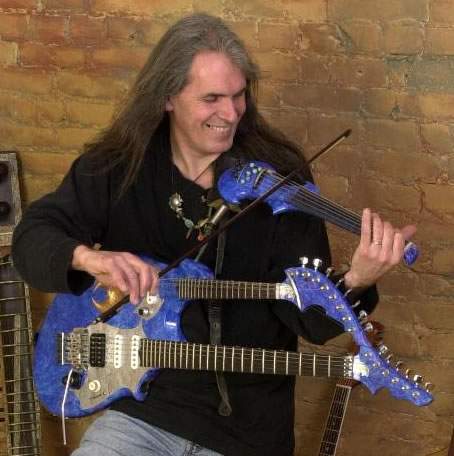
Some of the collection are traditional instruments from familiar places like the Balkans or India. Others are unique creations from the minds of mad geniuses such as the Trimeister pictured here. Inventor and musician Steve Hoke, developed the guitar/mandolin/fiddle over an evolving two-year process. When asked about the music it makes, Steve calls it "earth fusion".

While you are taking the grand tour, don't miss the beer organ playing the Beatles' Elenor Rigby.

[Submitted by Leah Silverman]

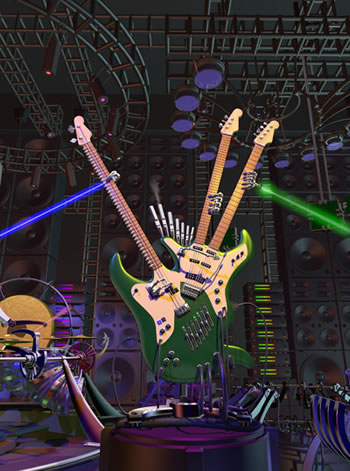
Pictured here is the Triple-Neck Guitar. This "virtual instrument" from the imaginations of Animusic, is a laser-firing, three-neck electric guitar that also has a mini pipe organ built in, plus robotic fingers for fretting and three armatures for picking and strumming. Not to mention a back-up rythm section with robotic drums! See video.

Oddmusic.com is for anyone interested in unique, unusual, ethnic, or experimental music and instruments. So whether you play stalagmites in a cave, the kaval, bow telegraph wires across the Nullarbor Plain, twist electrons by circuit bending, call whales on a Waterphone, or just love listening, this site is for you.

Showcasing the sounds, music, and instruments of artists and artisans from around the globe. From gourd music to electronic odysseys, harp guitars to industrial insect metal, from the beautiful to the bizarre.


peterdurand

Peter Durand is an artist, educator & visual facilitator based in Houston, Texas.

He is the founder of Alphachimp LLC, a visual facilitation company that helps clients understand and communicate complex systems visually. He is a leader in graphic facilitation and a professor at Northwestern University Pritzker School of Law.

Dance, Monkey, Dance


From Studio 360, Kurt Andersen actually looks at some of the weird little videos that people forward to their friends. And he's surprised at what he finds: a foul-mouthed riff and bad Flash animation that together approach greatness.

>> Listen to Studio 360
>> View Dance, Monkey, Dance

peterdurand

Peter Durand is an artist, educator & visual facilitator based in Houston, Texas.

He is the founder of Alphachimp LLC, a visual facilitation company that helps clients understand and communicate complex systems visually. He is a leader in graphic facilitation and a professor at Northwestern University Pritzker School of Law.

On Being Roddy

[from Jarrell McAlister]

After sending Monkey Cards to everybody I've ever met, I received this wonderful childhood story from a friend...

My monkey toy story...

I saw an mask in a magazine when I was a kid. They said it was a Planet of the Apes mask and the picture they had was Roddy MacDowell as the chimp like this...

I saved and scraped my $10 together (the most money I had ever spent on anything in my life at the time) and placed the mail order.

I waited weeks with bated breath and when it arrived, I ripped the box open and it was something like this!

I was devasted. My lesson, never believe you can actually be Roddy MacDowell. He is/was one of a kind.

peterdurand

Peter Durand is an artist, educator & visual facilitator based in Houston, Texas.

He is the founder of Alphachimp LLC, a visual facilitation company that helps clients understand and communicate complex systems visually. He is a leader in graphic facilitation and a professor at Northwestern University Pritzker School of Law.

Monk-E-Mail

Finally someone has invented a useful and productive tool for the modern work environment! Careerbuilder.com has taken it's current chimp-focused ad campaign and built Monk-E-Mail. This allows you to send animated chimp emails to very busy friends and co-workers. This is bound to raise productivity levels of the US economy easily by ten-fold or more!

[Thanks to Andrea Pokrzywinski]

Samples:
>> Happy Birthday, Banana!
>> A-Wam-Bop-A-Loo-Bop

peterdurand

Peter Durand is an artist, educator & visual facilitator based in Houston, Texas.

He is the founder of Alphachimp LLC, a visual facilitation company that helps clients understand and communicate complex systems visually. He is a leader in graphic facilitation and a professor at Northwestern University Pritzker School of Law.

Zoom Quilt

New Yorker cartoonist and scribemonkey Drew Dernavitch sends us this "cool-as-shiznit thingy" and encourages us to watch it in Flash.

Zoom Quilt is a collaboration of 15 artists strings together a thread of visuals in a 4-dimensional mural: Instead of walking along the painted landscape, you burrow into it.


peterdurand

Peter Durand is an artist, educator & visual facilitator based in Houston, Texas.

He is the founder of Alphachimp LLC, a visual facilitation company that helps clients understand and communicate complex systems visually. He is a leader in graphic facilitation and a professor at Northwestern University Pritzker School of Law.

A Sharper Chimp

Our friend and fellow monkey fan, Jarrell McAlister, has threatened to purchase this for us:

"Alive" Chimpanzee So Real, It's Unreal!

  • Amazing "Alive" Chimpanzee is a fully animated, life-size bust of the real animal.
  • "Alive" Chimpanzee can see, hear and feel in ways that allow him to interact intelligently with you, your family, your guests...and with baffled strangers.
  • Soulful eyes track movements using infrared "radar" vision; his ears have stereoscopic sound sensors; his skin reacts to contact with touch sensors all around.
  • Four distinctive emotional moods include "Curious," "Happy," "Fearful" and "Feisty."
  • Override his "natural" autonomous mode by using the wireless controller to communicate specific commands as far as 30 feet away.
  • A Sharper Image worldwide exclusive.

peterdurand

Peter Durand is an artist, educator & visual facilitator based in Houston, Texas.

He is the founder of Alphachimp LLC, a visual facilitation company that helps clients understand and communicate complex systems visually. He is a leader in graphic facilitation and a professor at Northwestern University Pritzker School of Law.

Cassini Mission finds Water on Saturn's Moon

[From Andrew Zolli, Curator of Pop!Tech]

In case you haven't already seen it in the major media, there's breathtaking news this week from PopTech 2005 speaker and our newest board member Carolyn Porco.


Carolyn and the rest of the Cassini mission team report finding signs of liquid water on Enceladus, one of Saturn's moons, making it one of only a small handful of places in the solar system that could plausibly support life. The team's discoveries from the tiny moon are amazing -- giant plumes of water shooting into space, more heat emerging from the south polar regions than here on Earth, and signs that complex organic molecules may lie on the surface. "If we did nothing else, these findings alone would have made the Cassini mission worthwhile," says Carolyn. We couldn't agree more!

For more information and stay on top of this breaking news, check out Carolyn's web site, ciclops.org or visit nytimes.com today for the full story. And keep an eye out for Alive From PopTech appearing on public television stations nationwide starting in May and June -- it features fantastic footage from Cassini and Carolyn's own eloquent thoughts on the nature of exploration and discovery. And be sure to stop by poptech.org for your ticket to PopTech 2006 and 2007 -- tickets are disappearing fast, and we'd love to see you there.

peterdurand

Peter Durand is an artist, educator & visual facilitator based in Houston, Texas.

He is the founder of Alphachimp LLC, a visual facilitation company that helps clients understand and communicate complex systems visually. He is a leader in graphic facilitation and a professor at Northwestern University Pritzker School of Law.

Mark Lynas and High Tide

With global temperatures higher now than they have been in 5,000 years, and greenhouse gas levels higher than they have been in over 20 million years, Mark Lynas argues that the problem of global climate change is now impossible to ignore.

Using Google Earth, Mark takes his Pop!Tech 2005 audience on a world tour from his Oxford home to areas he visited in researching his book High Tide, highlighting the damage already evident from global warming.

As projections show a rise in temperature of between 1 and 6 degrees over the next century, Mark reflects on the "crisis of biodiversity" that accompanies such a rise, including the death of the coral reefs and committing a third of all species alive today to extinction.


Mark Lynas was born in Fiji in 1973, and grew up in Peru, Spain and the UK. After gaining a first-class honours degree in history and politics from the University of Edinburgh (where he also edited the university's student newspaper), he joined a web start-up called OneWorld.net - helping turn it into the world's most-accessed internet portal for human rights and sustainable development issues. He was also active in the flourishing environmental direct action scene during the late 1990s, joining road protests and helping mount 'decontamination' exercises against genetically-modified crops, as well as participating in Reclaim the Streets protests in London and Oxford.


Since leaving OneWorld in 2000 to work full-time on climate change, Mark has also been active as a broadcast commentator and journalist, writing for the Guardian, Observer, New Statesman and various other publications, as well as appearing on radio and television news and discussion programmes ranging from Newsnight to the BBC World Service. His book High Tide: The Truth About Our Climate Crisis was published by Flamingo/HarperCollins on March 1, 2004. He lives in Oxford, but has given talks and presentations on climate change and his travels for High Tide as far away as the United States and Australia.


Bill Hayward Portraits

From Paul Germain:

I think what Bill Hayward does has some similarities to what you accomplish with your work. In pushing his collaborators to pick up simple utensils and use a different side of the brain, the result is always a different and unique portrait of that person’s identity.

In your case, you seem to push participants to see themselves and their surroundings differently by abandoning all traditional methods of doing so as well. No computers, no notepads, secretaries, tape recorders or post its. Stripping things down to a viceral level, if you will.

Bill has been at this style of photography/portraiture for quite some time and the results have been really amazing. He’s also got a nice size coffee table book out which basically shows his process with a number of public personalities.

Bad Behavior is a radical new approach to portraiture. Rather than photographing his subjects posed in front of the standard, neutral paper backdrop, photographer Bill Hayward boldly invites them to collaborate in transforming the backdrop in any way they choose. Armed with paper, scissors and paint, the subjects create fascinating, often amusing, and always revealing portraits. Some subjects use the backdrop to paint portraits of critical people or figures in their lives, some create landscapes, some write words or phrases, while others create entire stories. Many choose to transform not only the backdrop, but themselves--removing their clothes and/or painting their bodies.

Hayward's subjects are luminaries in a variety of fields: painters, actors, directors, dancers, writers, musicians, and poets.

peterdurand

Peter Durand is an artist, educator & visual facilitator based in Houston, Texas.

He is the founder of Alphachimp LLC, a visual facilitation company that helps clients understand and communicate complex systems visually. He is a leader in graphic facilitation and a professor at Northwestern University Pritzker School of Law.