Books for Soldiers


This is a soldier support site that ships books, DVDs and supplies to deployed soldiers and soldiers in VA hospitals, via our large volunteer network.


If you have old, but usuable books or DVDs sitting around, collecting dust, why not send them to a soldier for a big morale boost?


Many of our volunteers have received email and letters from the soldiers they have adopted.


Help us out, help the troops out, mail them your books.


If you are a blogger, you can help get the word out by posting one of their buttons on your site.


(thanks to Jarrell at DonkeyTop for the LINK. Special condolences to the family of Pfc. George D. Harrison, 22, of Knoxville, Tenn., died December 2 in Mosul, Iraq.)

peterdurand

Peter Durand is an artist, educator & visual facilitator based in Houston, Texas.

He is the founder of Alphachimp LLC, a visual facilitation company that helps clients understand and communicate complex systems visually. He is a leader in graphic facilitation and a professor at Northwestern University Pritzker School of Law.

Monkey Porn!?


"Monkeys are willing to 'pay' to check out pictures of other macaques' asses. Researchers at Duke University gave male rhesus macaques the choice of juice of a half-second glimpse of a picture of a female's rear or an image of a socially-dominant monkey."


(thanks Boing Boing! Original article at Current Biology)

peterdurand

Peter Durand is an artist, educator & visual facilitator based in Houston, Texas.

He is the founder of Alphachimp LLC, a visual facilitation company that helps clients understand and communicate complex systems visually. He is a leader in graphic facilitation and a professor at Northwestern University Pritzker School of Law.

Screaming Dean Continues to Ride the Wave

At a recent gathering, a fellow mentioned the importance of the internet in allowing communities to work together. Another one contended that the internet encourages to draw apart ("Look at the terrorists; they use the internet!").


Yet another noted the success of Howard Dean in the Presidential election.


"Yeh," came the sardonic reply. "But it didn't get him elected."


No. But it may have put him in the position to guide the formation of the Democratic National Committee for the next election.


When I laid the news on them that he may become the next Chairman of the DNC, they were incredulous. "No way!" they spewed. (And, no, we were not in a Red State, but in England).


According to the Associated Press, Dean already has more than 50 endorsements of DNC members, including five chairs. He needs a majority of the 447 members to win the post. The election is scheduled Feb. 12.


In the end, it was th groundswell of support from normal folk - self-organizing the Dean campaign themselves all across the country - who brought this former governor of Vermont to this national level.


LISTEN to Joe Trippi, Dean's campaign manager, as he describes what it was like to ride the wave of dedicated citizens using the web to come together for change.


Yee-haw!


peterdurand

Peter Durand is an artist, educator & visual facilitator based in Houston, Texas.

He is the founder of Alphachimp LLC, a visual facilitation company that helps clients understand and communicate complex systems visually. He is a leader in graphic facilitation and a professor at Northwestern University Pritzker School of Law.

Podcasting Hits the Big Time (or at least NPR)

Blogs grow from very personal text-based scribbles, to very personal vocal monologues. Now you can hear as well as read the angst, anxiety and antics!


Personal Radio Via Podcasting Grows More Popular

by Nathan Santamaria


LISTEN to NPR interview with the founder of iPodder.org, the inimitable Adam Curry, former DJ on MTV (see article on www.mtv.com).


Slate's Gizmos: The Future of Radio

Noah Adams

Day to Day, October 28, 2004


LISTEN as NPR talks to Paul Boutin of Slate about two new products for radio listeners: a portable satellite radio receiver, and a so-called "podcasting" system that allows iPod users to download radio programming.


PodCasting' to Music, Talk Fans Online

by Robert Smith

Day to Day, February 1, 2005


For a good time, visit the merry banter of married podcasters Dawn and Drew.


Via iPodder.org, we discovered Digital Strips : The Web Comics Blog

Description: "A blog of the web comics scene. Here you'll find reviews, links, and comments of our favorite digital comic strips. Space in newspapers for comics is shrinking, but the web is a wide open canvas."


However, for the best podcasts of the best content, nothing beats Doug Kaye's IT Conversations.


Want to become a broadcaster? Check out SHOUTcast, Nullsoft's Free Winamp-based distributed streaming audio system. It's Free! Check the online docs to get started! All you need is a player, for example Winamp, iTunes or RealPlayer.

peterdurand

Peter Durand is an artist, educator & visual facilitator based in Houston, Texas.

He is the founder of Alphachimp LLC, a visual facilitation company that helps clients understand and communicate complex systems visually. He is a leader in graphic facilitation and a professor at Northwestern University Pritzker School of Law.

Beyond Petroleum through Working Green


[SEE close-up.]


Even when immense fortunes are spent on vaulted, cathedral spires and overblown modern art, most corporate headquarters do not impress and much as boast


The offices of BP in Surrey, just outside of London, however, struck me viscerally – they seem to be putting their money where their mouth is.


Since merging with Amoco in 1998, and subsequently re-inventing their brand as "Beyond Petroleum", the British based multi-national oil company has promoted their research in alternative fuels, solar power and recycling. They define their brand values as such:

BP believes in being performance driven, innovative, progressive and green in everything we do and say.


I must admit: I have a deeply cynical prejudice towards such grand declarations.


When I hear: "Green in everything we do and say"; I say: "Ha! Easy to say, hard to do!"


Now, when filling my tank beneath BP's sunny green and yellow logo (filled with bright promises of clean skies, warm light and growing things), I'll admit to having been quite skeptical as to whether BP was truly walking the talk. However, the buildings lived up to the brand in every aspect.


The campus in Surrey is comprised of glass walls offices, seemingly suspended from mast-like spines that puncture the roof line, sending cables to all corners and cornices like vast office park galleons. At first blush, the impact is rather jarring, with long rows of metal blades hang from the sides like vast displays of razor blades. Sounds imposing and it is. But, it intrigues as well.


Very "ouchy" looking.


However, closer inspection reveals these "razors" to be rows and rows of solar panels. The post-modern street lights are actually halogen spots with reflective panels to bounce light in gentle pools at night.


Inside, every well crafted icon and information graphic speaks of recycling paper and bottles, and general awareness of safety and consideration. A small green gremlin mascot (apparently a metaphor for the evils of wastage) reminds the viewer that recycling even one plastic bottle saves the equivalent energy of burning a 60 watt light-bulb for three hours.


Each time I was escorted to another floor, I was verbally, but gently, reminded to hold on to the handrail for safety. Numerous posters admonish the use of cell phones (they cause distraction which can lead to accidents!) and even exhort turning them off inside the building.


The cafeteria redefined the corporate canteen: I loaded up with fresh squeezed carrot-orange juice, Mediterranean chicken and couscous, an apple, a banana and (because I've been good) sponge bread with custard. Even the BP cafeteria ladies were dressed more like crisp, sober Mennonites in stiff black caps and skirts, rather than the gruff, grease-stained, hair-net-totting cafeteria ladies of my youth.


Every chair was ergonomic, every bulb the non-flickering kind, usually bounced off of ceiling or wall instead of beating down on the office drones. In fact, there seemed to be no drones.


Let's hope they truly lead the way through their fourth and final "brand value":

Green - demonstrating environmental leadership


United around a vision of environmental leadership and recognition that the challenge to develop cleaner energy must be met, we are committed to the proactive and responsible treatment of our planet's natural resources and to the development of sources of lower carbon energy.


All in all, my visit gave me some hope for the future. If a big, bad oil company "gets it" when it comes to the importance of design, conservation, alternative fuel, renewable energy, safety, healthy work places and nice lunch ladies, there is hope for the rest.


NOTE: Postcard from London on sustainable architecture was posted by Jamais Cascio, contributor to Worldchanging.com Other suggestions for information on London's new initiatives was posted by Tim Aldrich of the Forum for the Future www.forumforthefuture.org.uk. Tim works for the London Sustainability Exchange - or LSx - which is aiming to make London the world's first sustainable world city. Lots of resources and info on what's going on in London.

peterdurand

Peter Durand is an artist, educator & visual facilitator based in Houston, Texas.

He is the founder of Alphachimp LLC, a visual facilitation company that helps clients understand and communicate complex systems visually. He is a leader in graphic facilitation and a professor at Northwestern University Pritzker School of Law.

Christopher Alexander Speaks the Secret Language of Patterns

Alexander attempts to define and understand the essence of a "living" structure. He talks with NPR's Jennifer Ludden onAll Things Considered, January 29, 2005.


LISTEN to Alexander's interview.


In the late 1970s, Christopher Alexander became an icon in the architecture world with his book, A Pattern Language. In it, he argued for injecting personal, emotional and spiritual qualities into manmade structures, streets and cities. Alexander's book challenged the architectural establishment and derided much that's been built over the past century as "deadly."


We were first exposed to his work by Matt and Gail Taylor, masters in designing living, collaborative spaces that accelerate innovation through releasing group genius.


The Taylor's work is infused with Alexander's theories of pattern language; as well as Howard Gardner's Multiple Intelliegences and Buckminster Fuller's work with tensigrity.

peterdurand

Peter Durand is an artist, educator & visual facilitator based in Houston, Texas.

He is the founder of Alphachimp LLC, a visual facilitation company that helps clients understand and communicate complex systems visually. He is a leader in graphic facilitation and a professor at Northwestern University Pritzker School of Law.

Zen and the Art of Homeland Security

Look up the word "Zen" and you will find hundreds of references, definitions, poems, artworks and masters of consciousness. You shan't, dear reader, find the Department of Homeland Security. More specifically, the TSA may be used to illustrate the opposite of Zen

Defining Zen

(noun)

1: school of Mahayana Buddhism asserting that enlightenment can come through meditation and intuition rather than faith; China and Japan [syn: Zen Buddhism]

2: a Buddhist doctrine that enlightenment can be attained through direct intuitive insight [syn: Zen Buddhism]

3: street name for the drug lysergic acid diethylamide


However, the founder of Chinese Zen, Bodhidharma, as depicted in a woodblock print by Yoshitoshi, looks like the ex-Hell's Angels baggage screener I ran across today in the Pittsburgh International Airport. (I swear that is a cigarette butt poking out of his Grizzly Adams beard!)


It must take a great deal of meditative self-awareness to stare out at the lines of weary, caffiene-addled travelers and their bulky carry-ons, each and every one a potential well-spring of mass destruction.


Remember: Remain calm, no matter what the threat level.


from wikipedia:

Zen teachings often criticize textual study and the pursuit of worldly accomplishments, concentrating primarily on meditation in pursuit of an unmediated awareness of the processes of the world and the mind.


Zen, however, is no mere quietistic doctrine: the Chinese Zen master Baizhang (720-814 CE), (Japanese: Hyakujo), left behind a famous saying which had been the guiding principle of his life, "A day without work is a day of no eating."


When Baizhan was thought to be too old to work in the garden, his devotees hid his gardening tools. In response to this, the master then refused to eat, saying "No working, no living."


And perhaps detachment from worldly events is required to make it to one's lunch break, a topic one hears often loudly discussed amongst the TSA agents (ex. "Man! Yolanda sure has been gone a long time on lunch break! My break's coming up in one hour and thrity-seven minutes!")


Out of sincere curiosity, I conducted a straw poll of TSA agents asking if they had any opinion of the new nominee for Department of Homeland Security, Michael Chertoff, currently a judge for the U.S. Court of Appeals for the Third Circuit.


The female agent screening me, responded that she thought it might be "The Admiral" who was replacing outgoing head Tom Ridge. I offered to her that it may be someone else. "You should find out; he'll be your boss."


She replied, "Well The Admiral spoke at the Inauguration; I assumed he was gonna be our next boss."


"So, you don't know for sure?"


"Nope," came the terse reply. "I don't know who signs my paycheck: I got direct deposit."


Whoa. Now there's a metaphor for Zen: "direct deposit for the soul."


I really hope that the vision of Ron Ruiz comes to fruition. His concept made the runner-up's circle for ID Fuel's Bonfire #3 organized around the theme of Hassle Free Travel. It may not mesh entirely with TSA's inspirational credo:

"Through partnerships with industry, TSA has deployed the latest technology to detect weapons and explosives in a variety of transportation environments."


However, Ruiz's zenful vision for a security checkpoint re-design, dubbed Luf, involves streams, reeds, and ambient music.


Ahhhhhh. Just like heaven, except with x-ray machines.


peterdurand

Peter Durand is an artist, educator & visual facilitator based in Houston, Texas.

He is the founder of Alphachimp LLC, a visual facilitation company that helps clients understand and communicate complex systems visually. He is a leader in graphic facilitation and a professor at Northwestern University Pritzker School of Law.

Tiny Keys to the Kingdom o' Blogs

I have been talking with many of my clients and partners in the field about this here blog phenomenon (doo-DOO-doodoodoo-FEE-nom-eee-NON!--doo-doo-DEE-doo).

Most ask: [1] Why should I care about blogs? or [2] How the hell do they work?

I think most professionals should care because both the technology and the social networks formed online are redistributing power and decision-making in the fields of commerce and politics.

At Pop!Tech 8, a pre-election panel discussion on "Connected Politics". Panelists included Joe Trippi, former campaing manager for Howard Dean; Adrian Wooldridge, Washington correspondent for The Economist and Andrew Rasiej, founder and chairman of MOUSE.

They addressed tough questions about the future of US politics and the roll of the "blogosphere" in shaping discourse:

  • What good does connected campaigning do if you don't have good candidates?
  • If the Republicans have the big ideas and the big think tanks. Will that change?
  • Why didn't Kerry [and the rest of the Dems] take advantage of the Dean machine?
  • What rules could we change?
  • Will more transparency make it harder for politicians to take tough positions?
  • What about the power of the special interests?
  • What are the features of communities where source flourishes.

To hear these speakers online, visit IT Conversations' podcast of Pop!Tech.

To understand how straight-forward business processes are being redefined, I would start off by listening to The Gilmor Gang discuss how this technology is driving business process and social dialog.

I've posted a list of resources that will be rudimentary for experienced bloggers but keys to the kindom for newbies (and, by all means, please add resources to the comments field!).

Look, learn, graze, cogitate, peruse, ideate and have fun!

Blog FAQs


What is an RSS feed?
RSS is a format used to syndicate news and other web content. This includes major news organizations such as The New York Times and Wired, but also covers blogs and other types of content. Sites that offer RSS-formatted content are accessible through a news aggregator such as NewsGator, which feeds and displays new items from each feed you track. MORE: http://www.newsgator.com/

What is a blog?
A blog is a journal, a running log of thoughts and or commentary that an author (or “blogger”) makes available for reading on a website. Blogging software allows bloggers to update their weblogs whenever they want. People reading the blog can respond to individual entries of the blogger, sometimes creating extended discussions.
MORE: http://www.blogger.com/tour_start.g

Blog History
Visit: wikipedia's brief history.

My Blog Favs


Worldchanging.com, is by far my favorite blog. It has dozens of contributers from around the world submitting posts on technologies and processes that are truly changing the world. www.worldchanging.com

Other blogs I frequent:


  • Thomas Barnett, author of "The Pentagon's New Map",
  • Ethan Zuckerman, founder of Tripod and GeekCorps,
  • near near future, which is exactly like it sounds.
  • Josh Rubin's: Cool Hunting, where one kind find the latest in technology, video games, art, design, and orchids.
  • Good Experience, Mark Hurst who specializes in on-line experiences and marketing,
  • ID Fuel, collaborative of five product designers conducting on-line prototype contests,
  • Kevin Kelly's Cool Tools, Kevin's site is a model of simplicity and elegance in weaving together his various interests. He also has put everything he has written on the web -- a sure fire way to ensure ultimate ownership and street credit for IP.
  • Creative Commons, is redefining the levels of ownership and usage on the web. Most blogs subscribe to their guidelines.
  • IT Conversations, Doug Kaye, a former radio producer, uses blogs for "podcasting" of interviews and conferences. I could totally see how a series of AWAW interviews with Mark Bryan could work streamed over the web! This weekend I listened to a wonderful panel on Emotion Life.

A master list of blogs and RSS search engines can be found through Fagan Finder.

Books


Joe Trippi The Revolution Will Not Be Televised : Democracy, the Internet, and the Overthrow of Everything
Description: When Joe Trippi signed on to manage Howard Dean's 2004 presidential campaign, the long-shot candidate had 432 known supporters and $100,000 in the bank. Within a year, Trippi and his energetic but inexperienced team had transformed the most obscure horse in the field into a front-runner, creating a groundswell of 640,000 people and raising more money than any Democrat in history -- more than fifty million dollars -- mostly through donations of one hundred dollars or less.

Dan Gillmor's We the Media: Grassroots Journalism by the People, for the People
Gilmor's observation that the common man (with internet access) is now the media, able to conteract the mainstream, and take on networks and governments using social nets, cell phones, pages, SMS and blogs.

Best Blog Companies


Blogger
TypePad

News Aggregators


NewsGator
NewsNetWire
Bloglines
SEE MORE on a fantastic Yahoo List

Blogcasting Tech Specs


On Blogcasting

peterdurand

Peter Durand is an artist, educator & visual facilitator based in Houston, Texas.

He is the founder of Alphachimp LLC, a visual facilitation company that helps clients understand and communicate complex systems visually. He is a leader in graphic facilitation and a professor at Northwestern University Pritzker School of Law.

Regarding Snow, Go with Those Who Know

In general, I agree with a favorite Canadian saying: There is no bad weather, only bad clothing.


However, even the best jacket from REI will only take you so far.


Paleoclimatologist Richard Alley studies ice cores -- samples of ice that record Earth's past climate. His research focuses on abrupt climate change, glaciers, ice sheet collapse and sea level change. He has participated in ice core drilling projects in Antarctica and Greenland and has won many awards for teaching and research. We caught him at this the 2004 Pop!Tech as part of a panel discussion on "Big Weather". Listen at IT Conversations.


From Joho the Blog:

"[Alley is] an animated speaker. He shows photos of his ice-drilling expedition to Greenland. Is there global warming? Yes. He runs through the evidence. The biggest cause is fossil guels: The typical US driver buys 100 pounds of gasoline per week. We're burning fossil fuels a million times faster than nature created them. Climate? What? Me, worry?Global warming is a natural trend but we're making it much worse. Most of the effects of global warming are negative for humans, he says. Some high-latitude economies will do better. But, it could dry up the grain-belt, kill off a whole bunch of species, raise sea-level and spread tropical diseases. [Ok, overall, I'm against global warming.] It's hard to make it better but easy to make it worse. Alley hypothesizes that the climate moves by staggering up and down. He shows a chart that shows that in the Ice Age, the temperature staggered but the CO2 level changed rather smoothly. Possible conclusion: Now that CO2 is rising again, we should perhaps expect big swings in temperature. Alley shows satellite photos of the ice sheets in Antarctica. They're melting. These are just small ones. But it's possible the large ones will melt. Goodbye Florida."
If you want to read what real, live, actual climatologists are discovering about our changing weather, check out the collaborative blog RealClimate, a commentary site on climate science by working climate scientists for the interested public and journalists. We aim to provide a quick response to developing stories and provide the context sometimes missing in mainstream commentary. The discussion here is restricted to scientific topics and will not get involved in any political or economic implications of the science.


Check out Ben Saunders' weblog and read a first hand account of preparing for--and successfully executing--the first ever solo and unsupported ski crossing of the Arctic Ocean. This 1,240 mile (1,996km) journey had never been completed solo without resupply. Ben also has a fantastic collections of photographs from past treks and a gorgeous interface for his blog, including peaceful Flash slideshows.


British Artist Simon Faithfull travelled to the coast of Antarctica and back with the British Antarctic Survey and sent back daily Palm-Pilot sketches to document his journey and 'look at what it is that fascinates us still about this beautiful emptiness'.


Travelling with the British Antarctic Survey (BAS), I will journey to the Falklands via Ascension Island, where I will join BAS scientists on board the ice-strengthened ship RSS Ernest Shackleton. On its way South the ship will visit several subantarctic islands, break through expanses of sea-ice and ultimately reach the ice cliffs of Antarctica. More than a month after leaving England, the sketches will record the final journey inland to the strange science-fiction-like Halley Research Station perched on stilts above the empty, white wilderness of Antarctica.


Using the extremely restricted means of the Palm-Pilot, the pixellated drawings might depict any number of things: a detail of the ship, a weather balloon disappearing, an abandoned whaling station, Shackleton's grave, a colony of penguins, a wandering Albatross or a drifting iceberg. The project will convey the extreme mechanics of the journey, the tedium of isolation and the awful beauty of a journey into the void. Ultimately the work will look at what it is that fascinates us still about this beautiful emptiness.


"…whiteness is not so much a color as the visible absence of color, and at the same time the concrete of all colors; is it for these reasons that there is such a dumb blankness, full of meaning, in a wide landscape of snows…" The Whiteness of The Whale. Moby Dick, Herman Melville

peterdurand

Peter Durand is an artist, educator & visual facilitator based in Houston, Texas.

He is the founder of Alphachimp LLC, a visual facilitation company that helps clients understand and communicate complex systems visually. He is a leader in graphic facilitation and a professor at Northwestern University Pritzker School of Law.

Gen X Daddy


All my friends are there, man, living life as a Gen X Daddy! Finally, some press.


Some great "daddyblogs" out there for those of us juggling family, work and late-night obsession with crafting on-line dispatches.


Daddytypes

The Weblog for New Dads


Being Daddy

tagline: "Like being Mommy. Only hairier."


Daddyzine

"Though I refer to it in public as 'a potty,' I still come off looking very masculine.


Appearantly we are all foregoing big careers and fancy vacation homes in lieu of paternity leave.


All I know is that when I am working from home, the freedom to break for a game of peek-a-boo with my 11-month-old daughter is bliss. On the other hand, working on the road is even more of a drag!


Meet a group of like-minded fathers who call themselves ''Dads in the Dark'' meet monthly at Conley's in Watertown after their kids are safely tucked in for the night:

  • Boston Globe photo essay

  • Article


  • Keep on keeping on, brothers! And, have a beer for me.


    Luxury vacations, fast-track careers, and bigger houses used to be a priority for family men, but no longer. Today's young fathers are taking paternity leaves, rejecting overtime, and rushing home after work to do all the things many of their own fathers didn't...


    Even at a time when men are working as hard as ever, much has been made of the emergence of the new nurturing father. Around the time that Dustin Hoffman asked in the 1979 movie Kramer vs. Kramer, "What law is it that says a woman is a better parent simply by virtue of her sex?" sociologists were hailing a new era. Study after study shows that today's men refuse to be stick figures in their children's lives. They recoil at the thought of acting like Distant Dad. When they see celebrities like Eminem and Will Smith embrace their children or Super Bowl winners cradle their babies, they see glamorous reflections of themselves.


    No generation is more influenced by this vision of fatherhood than today's men between 26 and 40 - commonly called Generation X - and no male age group has been more scrutinized for its paternal behaviors. As research targets, men of this generation have been asked to keep daily diaries of time spent at work and home, to distinguish between reading bedtime stories (child care) and washing dishes (housework), and to know that being a "domestic manager" is not the same as being a "compliant helper."


    (via Daddytypes)

    peterdurand

    Peter Durand is an artist, educator & visual facilitator based in Houston, Texas.

    He is the founder of Alphachimp LLC, a visual facilitation company that helps clients understand and communicate complex systems visually. He is a leader in graphic facilitation and a professor at Northwestern University Pritzker School of Law.

    Journalist David Bornstein Visits Southwestern PA

    Award-winning journalist David Bornstein is coming to Southwestern PA on Thursday, January 20 to promote his highly acclaimed book, "How To Change the World: Social Entrepreneurs and the Power of New Ideas". In this book, Bornstein profiles nine remarkable social entrepreneurs, described as driven, creative people who question the status quo, exploit new opportunities, refuse to give up, and remake the world for the better. During his visit, Bornstein will discuss how social entrepreneurs bring about positive social change in our country and around the globe. There are two opportunities to meet David and hear him speak...


    1. Thursday, January 20th, 9:00-10:30am at the Westmoreland Museum of American Art in Greensburg. This session is for all nonprofits in Westmoreland and surrounding counties. To register, please contact the Westmoreland Museum of American Art at (724) 837-1500, ext 29.


    2. Thursday, January 20th, 1:30-3pm at the Pittsburgh Project (http://www.pittsburghproject.org/) on the Northside. The address will be followed by a panel moderated by Gregg Behr (Forbes Funds) and including Jeff Palmer (CEO of the Coordinated Care Network and an Ashoka Fellow), Tim Zak (President, Pittsburgh Social Enterprise Accelerator), Peggy Outon (Executive Director, Bayer Center for Nonprofit Management), and Terry Beggy (Executive Director, PSVP). Register by calling the Bayer Center for Nonprofit Management at 412-227-6814.


    Sponsors of this visit include the Pittsburgh Social Enterprise Advisory Committee, The Forbes Funds, the Bayer Center for Nonprofit Management, the Nonprofit Leadership Institute, ProArts, the Westmoreland Museum of American Art, the United Way of Westmoreland County, and the Community Foundation of Westmoreland County.


    Don't miss an opportunity to meet this renowned author and journalist and hear about his incredible global journeys to find individuals literally changing the world!

    peterdurand

    Peter Durand is an artist, educator & visual facilitator based in Houston, Texas.

    He is the founder of Alphachimp LLC, a visual facilitation company that helps clients understand and communicate complex systems visually. He is a leader in graphic facilitation and a professor at Northwestern University Pritzker School of Law.

    The Guerrilla, the Entrepreneur and the Motivation to Change the World

    Reading two or more good books at a time can be like holding two mirrors up to each other; the ideas reflect the other and creates a tunnel through time and space. The effects can be trippy.


    Two of the three books I'm reading sketch out mirror figures of the passionate revolutionary: the guerilla and the social entrepreneur.

    The Social Entrepreneur


    A detailed look at the motivations and trials of Ashoka Fellows is chronicled in How to Change the World: Social Entrepreneurs and the Power of New Ideas by David Bornstein.


    These passionate social entrepreneurs have been tapped by the organization to transfer a social mission into a social enterprise. The Fellowship provides the time and resources for Fellows to quit their jobs and concentrate energy on hammering out the business processes, fundraising, generating community participation and driving political will to ensure measurable change.


    Bill Drayton, former head of the EPA and McKinsey consultant, defines the four qualities of the social entrepreneur as:

  • Creativity: Both the ability to set goals in the future and the chutzbah and agility to overcome obstacles.

  • Entrepreneurial Quality: Beyond altruism, energy and managerial skills, Ashoka asks, "Will this person change the pattern in the whole field?" Drayton sums up how they differ from artists, social workers and academics, saying that entrepreneurs can't rest until their ideas take hold across all of society; they stay up at night asking "how-to" questions in a quest to bring theory into action.

  • Idea Resilience: Will the idea outlast the entrepreneur? How many lives will be affected or improved?

  • Ethical Fiber: Drayton tells others to go with their gut and ask themselves, "In a dangerous situation, would you be totally at ease if this person were with you?"


  • Bornstein's blog has a detailed story tracing the evolution of one man's motivation to become a social entrepreneur.


    The Guerrilla


    Oddly enough, investigative journalist, Jon Lee Anderson has asked the same questions about self-proclaimed freedom fighter as Bornstein has asked regarding entrepreneurs. Namely, why do guerilla fighters endure the hardship, degradation, danger, tedium and isolation of live on the run? Why do they risk everything to fight for an ideal; one which they may never see take hold in the their lifetimes?


    Anderson's earlier work, Guerrillas: Journeys in the Insurgent World, originally published in 1992, has been re-released with a new foreword, in which the author emphasizes the dangers of assuming we understand "the insurgents" we face in Iraq.


    As a storyteller his writing is consistently rich and humane. As a journalist , he adroitly crafts a probing analysis of the motivational factors driving young men and woman to join insurgent factions in areas as diverse as El Salvador, Western Sahara, Palestine and Burma.


    "Guerillas are people living in defiance of their would-be conquerors, according to their own laws and beliefs, telling their own stories and legends--making history," writes Anderson in the new foreword.


    His book looks across the motivations of the different groups, with the author involving us in the texture and patterns of life inside the parallel reality of each movement. Anderson examines the hardships of making war while making a living, retelling each group's unique "myths of creation" that give meaning and justification to the resistance. He finds that each faction evolves its own system of justice and rules for joining The Family; death, in most cases, seems to be the only way out.


    A writer who has survived battle zones in El Salvador, Afghanistan and many parts of Africa and Asia, Jon Lee Anderson remained in Iraq during the American invasion and published a first-hand account in The Fall of Baghdad.


    His book on Cuban revolutionary, Che Guevara: A Revolutionary Life (1997) is the book that established Anderson's reputation as one of the great foreign correspondents of his time.


    On Global Guerrillas


    For a constantly updated blog on the topic, look to John Robb. He has lived, worked, and traveled extensively in Central/South America, Africa, Asia, and Europe. Robb served at the Department of Defense Counter-terrorism in a tier one counter-terrorist unit that worked closely with Delta and Seal Team 6; he was a top technology analyst covering Internet technologies at Forrester Research; and, he built a company and grew it from $0 to over $23 m a year in revenue and 135 people. This gives him a unique view of the motivations behind both the guerilla and the startup entrepreneur.


    PHOTO: Infantry securing main gun hole, An Najaf, 14-AUG-2004, John Baker


    Robb examines the influence of connectivity on the effectiveness of small distributed networks to inflict maximum damage on big systems (like the US military).


    In global guerrilla warfare (a combination of open source innovation, bazaar transactions, and low tech weapons), the point of greatest emphasis is called a systempunkt. It is the point in a system (either an infrastructure or a market), always identified by autonomous groups within the bazaar, where a swarm of small insults will cause a cascade of collapse in the targeted system.


    www.globalguerrillas.typepad.com/globalguerrillas/

    peterdurand

    Peter Durand is an artist, educator & visual facilitator based in Houston, Texas.

    He is the founder of Alphachimp LLC, a visual facilitation company that helps clients understand and communicate complex systems visually. He is a leader in graphic facilitation and a professor at Northwestern University Pritzker School of Law.

    Artists Embedded in War


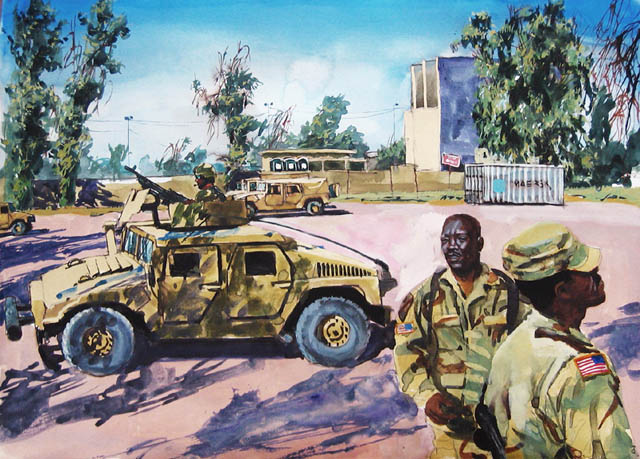
    Forward Operating Base (FOB) Cuervo in Baghdad. Steve Mumford, 2004.


    Much has been made of the embedded journalists in Iraq, but what of other types embedded artists?


    This week's show of NPR's This American Life with host Ira Glass, was titled "In Country: Stories from inside Iraq". It included interviews with Arkansas National Guardsmen stationed a few miles from Baghdad and clips from a new documentary TV series about them, Off to War, on the Discovery channel.


    This unit shipped to Iraq with trucks manufactured between 1956 and 1964. Only four of 44 vehicles had proper armor when they arrived. The documentary follows several soldiers and their families back home.


    During the First Gulf War, Executive Producer of the documentary, Jon Alpert, entered Baghdad at the height of the bombing. He was the only TV reporter able to get out of the country with uncensored footage. He provided the first documentation of extensive civilian deaths caused by the bombing. His reports were awarded the Italian Peace Prize by the president of Italy. One year after the war, Alpert returned to Baghdad to conduct an exclusive interview with Saddam Hussein.


    Brothers, Brent and Craig Renaud, were born and raised in Little Rock, Ark and have been working with Alpert since 1995 on projects in Afghanistan, Cambodia, Bolivia, China, Pakistan and Iraq.


    Listen to NPR's Scott Simon interview with the Renaud Brothers, Weekend Edition - Saturday, November 6, 2004.


    The same show also profiled Steve Mumford, an embedded artist creating sketches and paintings of the scenes he's witnessed in Iraq: patrols, arms cache demolitions, raids, roadblocks, and life in Forward Operating Bases or FOBs.


    [ More News from Iraq via New York Times International ]


    Art and war have been emeshed through the centuries. The 19th century Spanish artist Goya produced hundreds of images, including a vast series of prints, titles "Disasters in War", depicting the ravages of Napoleon's army in Spain.


    Francisco de Goya. Desastre de la Guerra, 39;  Grande Bazana! Con Muertos! c.1810-1811. Etching and aquatint.


    However, it wasn't really until the 20th century that a generation of artists unleashed an unromanticized vision of war after serving in the armies of Europe during World War I.


    The Night by Max Beckmann. 1918-19. Oil on canvas. 52 3/8 in x 601/4 in.

    Kunstsammlung Nordrhein-Westfalen, Dusseldorf
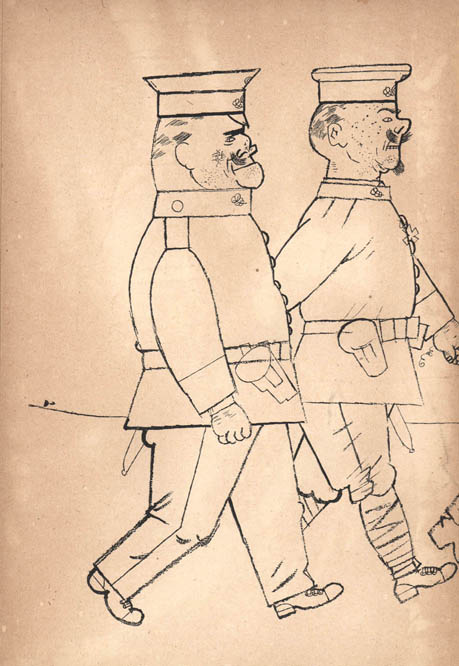


    Wieland Herzfelde. Tragigrotesken der Nacht: Träume. Illustrated by George Grosz. Berlin: Malik Verlag, 1920.


    Die Bruecke and other German Expressionists, such as Beckmann, George Grosz and Otto Dix, used a fast, aggressive visual language inspired by folk art to convey the emotionally torn fabric of 1920's Europe.


    During World War II, young American artists like Ed Reep, were swept up in the conflict as active duty soldiers, but saw the war through the keen eye of the artist.


    Soon after graduating from The Art Center School, and five months before the attack on Pearl Harbor, Reep enlisted in the Army as a Private. After getting an assignment as an Overseas Artist, Reep skeched and painted throughout North Africa and Italy. He often found himself in the thick of battle and was repeatedly strafed, bombed, and shot at while painting the war. He was awarded the Bronze Star, promoted twice on the battlefield and left the army as a Captain.


    During World War II more than 100 U.S. servicemen and civilians served as 'combat artists'. They depicted the war as they experienced it with their paintbrushes and pens. Their stories have never been told, and for fifty years their artwork, consisting of more than 12,000 pieces has been largely forgotten until the PBS documentary, They Drew Fire, aired in May 2000.


    I fought the war more furiously perhaps with my paintbrush than with my weapons. And I always put myself in a position where I could witness or be a part of the fighting. That was my job, I felt. And I was young, kind of crazy, I suppose. ~Ed Reep


    Modern day artist Joe Sacco carries that tradition into the evolving genre of comics, graphic novels, and a new form of visual journalism. Sacco takes his first-hand experiences in listening to survivors in Bosnia, the West Bank and Palestinian refugee camps.


    His artwork guides us through tense, lucid narratives, packed with detail, in Safe Area Gorazde and his two part masterpiece, Palestine.


    The ultimate embedded artist is Art Spiegelman, most famous for his Pulizter Prize winning graphic novel Maus Parts I & II.


    His work is inspired by woodcuts and comics from the 1920s and 1930s, and Maus uses the metaphor of cat and mouse in the retelling of his father's experiences as a Polish Jew in wartime Warsaw and Auschwitz, and later as an aging immigrant in New York coping with the loss of his wife.


    "Maus is a book that cannot be put down, truly, even to sleep. When two of the mice speak of love, you are moved, when they suffer, you weep. Slowly through this little tale comprised of suffering, humor and life's daily trials, you are captivated by the language of an old Eastern European family, and drawn into the gentle and mesmerizing rhythm, and when you finish Maus, you are unhappy to have left that magical world."

    ~Umberto Eco


    Spiegelman's most recent work, the tabloid sized book reflecting the very real–and very surreal–streets of Manhattan on and after 9/11.


    In struggling to find a new visual language to frame the events and convey both the comedy and tragedy of the situation, Spiegelman turned back a hundred years to the masters of the broadsheet comics. In an essay, Spiegelmann explains that the artists of the comic strips our great-grandparents may have read as kids, like the Katzenjammer Kids and Little Nemo, were also dealing with the chaos of their age: urban growth, mass immigration, political corruption, ethnic tension, civil unrest in Europe and the US.


    Spiegelman and his family bore witness to the attacks in their lower Manhattan neighborhood: his teenage daughter had started school directly below the towers days earlier, and they had lived in the area for years. But the horrors they survived that morning were only the beginning for Spiegelman, as his anguish was quickly displaced by fury at the U.S. government, which shamelessly co-opted the events for its own preconceived agenda."

    ~from publishers Random House

    peterdurand

    Peter Durand is an artist, educator & visual facilitator based in Houston, Texas.

    He is the founder of Alphachimp LLC, a visual facilitation company that helps clients understand and communicate complex systems visually. He is a leader in graphic facilitation and a professor at Northwestern University Pritzker School of Law.

    BaseCamp: High Altitude Project Management Tool

    BaseCamp is subscription software, PHP publishing, I think, that is scaleable according to how many projects you need to manage at once. Check out the details below and get organized!


    1 project=free

    3 projects = $12/month

    15 projects = $24/month

    35 projects = $49/month

    unlimited projects = $99/month


    Sounds expensive, except that it allows the user to set permissions for unlimited users, who aren't required to pay anything or to have any additional software beside their web browser.


    We started less than a month ago with the 3 project plan, and it swiftly became so core to our business processes, we upgraded immediately. Now we are evangelizing BaseCamp to all our clients. They have a really great BaseCamp Manifesto. So far, they are living up to it and making our mom-and-pop shop a happier place to work.

    peterdurand

    Peter Durand is an artist, educator & visual facilitator based in Houston, Texas.

    He is the founder of Alphachimp LLC, a visual facilitation company that helps clients understand and communicate complex systems visually. He is a leader in graphic facilitation and a professor at Northwestern University Pritzker School of Law.

    Looking at Houston's Future

    Alphachimp Studio is excited to join Russell Williams Group and Collaborative Strategies, Inc. in facilitating several sessions for the leadership of the Center for Houston's Future.

    Read inteview from CHF newsletter.


    See DigitalGlobe satellite image of Reliant Stadium in Houston, where Superbowl XXXVIII was played between the New England Patriots and the Carolina Panthers on February 1, 2004.DOWNLOAD


    Most American cities and regions are planning for rampant growth, in the face of collosal deficits. And, any city leader worth his salt is asking tough questions about the future.


  • Energy: How are we going to keep the lights on in the face of higher demand and peaking oil reserves?

  • Brand Strategy: How do we understanding the shifting identity of our cities?

  • The Creative Class: What areas are attracting and retaining the most talented people, and how?

  • Game Theory: How can technology--especially simulations and advanced modeling--predict the problems and solutions of entire regions?

  • Population: How are we going to provide adequate housing without losing the soul of our neighborhoods?


  • Check out The Next American City for great articles and interviews tackling these issues. http://www.americancity.org/


    The magazine describes itself as:

    ...a new quarterly magazine by a new generation of urban thinkers and leaders that explores the transformation of America's cities and suburbs, asking tough questions about how and why our built environment, economy, society and culture are changing.


    Selected Articles


  • HUB CITY: Can Chicago Capture the New Economy the Old Fashioned Way? by Charles Shaw

  • REVIEW: Richard Florida, The Rise of the Creative Class (And How It's Transforming Work, Leisure, and Everyday Life) by Mackenzie Baris

  • PLAYING WITH URBAN LIFE: How Simcity Influences Planning Culture by Daniel G. Lobo with reporting by Larry Schooler

  • 15 MINUTES WITH: Rich Richman, One of the Country's Foremost Affordable Housing Developers by Seth A. Brown

  • NEIGHBORHOODS: Is East Atlanta Losing Its Soul? by Andrea Korber

  • peterdurand

    Peter Durand is an artist, educator & visual facilitator based in Houston, Texas.

    He is the founder of Alphachimp LLC, a visual facilitation company that helps clients understand and communicate complex systems visually. He is a leader in graphic facilitation and a professor at Northwestern University Pritzker School of Law.

    Tips on How to Change the World

    David Bornstein, author of How to Change the World, has started a blog to capture stories from the field of social entrepreneurs. He has posted a fantastic story, titled Where does the motivation to cause change come from?, about Kailash Satyarth, the founder of the South Asian Coalition on Child Servitude (SACCS), an organization based in Delhi, India that has reportedly won release for 40,000 slave laborers, many of them children.


    From the "Fair Play" Campaign:

    "SACCS/BBAwould like to have ministers, leaders of opposition parties, MLAs, foreign diplomats, officers, public servants, celebrities, and businessmen declaring that they will not use children as domestic servants. Following this, SACCS/BBA would like to investigate some of them on their use of domestic child labour."


    Through his weblog, Social Entrepreneurs and the Power of New Ideas, David cued me into Echoing Green, a group that is building capacity in the area of social enterprise through identifying visionaries, investing in innovation, providing hands-on support and connecting people. They have a great set of articles and how-to tips for organizations ranging from managing people and technology to building strong boards and maximizing the media.


    About Echoing Green


    Launched in 1987, Echoing Green's mission is to spark social change by identifying, investing and supporting the world's most exceptional emerging leaders and the organizations they launch.


    Through a two-year fellowship program, we help our network of visionaries develop new solutions to society's most difficult problems. These social entrepreneurs and their organizations work to close deeply-rooted social, economic and political inequities to ensure equal access and to help all individuals reach his/her potential.


    Over the past 17 years, Echoing Green has invested over $22 million in seed and start up grants to over 380 social entrepreneurs and their innovative organizations.

    peterdurand

    Peter Durand is an artist, educator & visual facilitator based in Houston, Texas.

    He is the founder of Alphachimp LLC, a visual facilitation company that helps clients understand and communicate complex systems visually. He is a leader in graphic facilitation and a professor at Northwestern University Pritzker School of Law.

    Hemmingway's Notes on Dangerous Game

    More commentary on the difference between professionals and amateurs:

    "For any good man would rather take chances anyday with his life than with his livelihood and that is the main point about professionals that amateurs seem never to appreciate."

    ~ Ernest Hemmingway, "Notes on Dangerous Game: The Third Tanganyika Letter", Esquire: July 1934


    (sketchbook from modern day Tanzania--formerly Tanganyika. Peter Durand, 1999)

    peterdurand

    Peter Durand is an artist, educator & visual facilitator based in Houston, Texas.

    He is the founder of Alphachimp LLC, a visual facilitation company that helps clients understand and communicate complex systems visually. He is a leader in graphic facilitation and a professor at Northwestern University Pritzker School of Law.

    On Writing Well (Part 2)

    After my post on Blogging for a Better World through Writing Well, I was sent another gem from journalist and columnist for the Pittsburgh Post-Gazette, our friend and neighbor Diana Nelson Jones:


    Some words and phrases are blobs. Others are paintbrushes whose narrow meanings instantly create pictures in the reader's mind. They are specific and concrete, not general and abstract. A storyteller uses paintbrushes when he or she can. If nouns like problem, situation, reaction or benefit tumble thoughtlessly from his typewriter, he immediately stops to ask himself if he can be more specific, more pictorial. What is the problem, situation, reaction or benefit he refers to? Can he toss out the blob and replace it with a term carrying needle-sharp precision?


    ~ William Blundell, "The Art and Craft of Feature Writing"

    peterdurand

    Peter Durand is an artist, educator & visual facilitator based in Houston, Texas.

    He is the founder of Alphachimp LLC, a visual facilitation company that helps clients understand and communicate complex systems visually. He is a leader in graphic facilitation and a professor at Northwestern University Pritzker School of Law.

    Christmas in the Balkans

    Writer Bruce Sterling spent this winter holiday in the Serbian capital of Beograde.


    With even the news in Iraq obscured by the tsunami catastrophe, it is hard to remember the news 10 years ago: The Soviet Union had dissolved; the Russian army pulled out of Eastern Europe; civil war rippled across the Balkans; and, the UN was bogged down by scandel and indecision watching an unfolding human tragedy.


    In 1994, Christmas was a very bleak time in the Balkans. There was the slow-motion genocide of Bosnian Serbs, Croats, and Moslems grinding on. Sarajevo was smack in the middle of a 1477 seige (lasting from March 2, 1992 to March 19, 1996).


    Susan Sontag, who died last week, was still coping with the effects of cancer treatment when she left for the Bosnian capital, surrounded by Serb artillery and snipers.


    From The Guardian


    "There is something about facing a mortal illness that means you never completely come back. Once you've had the death sentence, you have taken on board in a deeper way the knowledge of your own mortality. You don't stare at the sun and you don't stare at your own death either. You do gain something from these dramatic and painful experiences but you also are diminished. There's something in you that becomes permanently sad and a little bit posthumous. And there's something in you that's permanently strengthened or deepened. It's called having a life."


    It was this mindset that took her to a besieged Sarajevo in the early 90s to direct Beckett's Waiting For Godot to the sound of bombing and sniper fire. Alan Little, who attended the opening night, described her presence there as being of "tremendous symbolic importance at a time when symbols really mattered. She didn't just swan in for three days and then leave. She stayed and worked." But she says few of her American friends understood her commitment.


    Terry Gross brings us Sontag's story on NPR's Fresh Air.


    A "Surviaval Map" depicting Sarajevo under attack.


    Fortunately, the arts survived in Bosnia, and Sarajevo plays hosts to many festivals throughout the year. Nebojsa Seric-Soba is a 33-year-old Bosnian artist who stayed in Sarajevo through the war and formulated an artistic credo under the siege.


    As a soldier he thought about war but dreamed about art.


    During the day, when his imagination carried him away, he jokingly thought about the possibility that art and war might intersect on the battle field.


    PHOTO:Bruce Sterling


    More about art in Sarajevo at Q+A: A magazine of Art and Culture.

    More maps and resources on Bosnia from the University of Texas, Austin here.

    peterdurand

    Peter Durand is an artist, educator & visual facilitator based in Houston, Texas.

    He is the founder of Alphachimp LLC, a visual facilitation company that helps clients understand and communicate complex systems visually. He is a leader in graphic facilitation and a professor at Northwestern University Pritzker School of Law.

    Blogging for a Better World through Writing Well


    Click for enlargement


    By far, the biggest influence on me this year has been BlogNation. And, the best in the bunch is the crew at www.worldchanging.com.


    Since scribing for Alex Steffen's speech at Pop!Tech this October, I have been inspired to rise to the Worldchanging standard of publishing, in terms of:


  • Awareness of trends and tools

  • Collaboration with like-minded souls

  • Searching for meaning and utility

  • Publishing (ala PHP and blogware)

  • Social enterprise and entrepreneurs

  • And, most difficult, good writing


  • As we at Alphachimp try to raise the bar in sharing thoughts and tools on visual learning, graphic facilitation, problem solving, strategic planning, etc. we are always looking for simple rules to give structure to our work.


    I find the Worldchanging's Draft Contributor Guidelines to be more than worthy of emulation.


    1) Only positive recommendations. It's fine to review a tool which is itself critical or negative, but only if it offers something unique and useful to people working on that problem (or seeking to understand it). For example, Alex plans to review a book which describes the anatomy of failure � why things fail, and how � because its critical insights are really useful to people who want to succeed in their work. But the recommendation of the resource itself should be positive, overall: otherwise, why are we wasting the reader's time?


    2) Always a fresh angle. The resource reviewed should be either new (or newly-available), or the recommendation should explain why we're recommending this resource *now*: has there been a news event which this resource helps to better explain, or is an inferior new resource getting a lot of buzz (such that readers would be well-reminded of the existence of this older, superior one?)


    3) Pithy writing. Write short and strong. In general, while we like to prattle on (especially Alex), we aim for short recommendations, no more than three paragraphs(some things take longer to explain, and sometimes you'll want to review several related items in one recommendation, but the denser and pithier the writing, the better). Try to start with a strong, declarative first sentence.


    4) Excerpts. Including a few quotes from the resource recommended is a great idea. We italicize all stand-alone quotes, as well as putting in quotation marks. If you have a longer excerpt, you might think about pasting most of it into the "extended entry" box, which allows those who are interested to read more, while keeping the front page tight. A good guideline for choosing excerpts is that of the old Whole Earth Review, which is that a great excerpt illustrates the nature of the resource you're recommending and also provides an interesting thought or crucial bit of information for the casual reader who won't follow the link. Cherry-pick, in other words: pull the best quotes from the resource as excerpts in your recommendation.


    5) Why It Matters. It's a good idea to include not only a description of what the resource is but also some explanation about why it matters: Why is it good? How is it useful? How do you use it? What's innovative about it? What are the implications if its use were to spread? Feel free to be opinionated!


    Eventually, everyone I know who writes for a living--whether prose, fiction or code--gets cornered by me at a dinner party, and gets pestered for references and guides on writing well, for print and web alike.


    Columnist for the Pittsburgh Post-Gazette, Diana Nelson Jones, recommends the tried and true The Elements of Style by William Strunk, Jr. and E.B. White. A very handy on-line version is available at www.bartleby.com, which describes the work, originally published in 1918, as such:

    Asserting that one must first know the rules to break them, this classic reference book is a must-have for any student and conscientious writer. Intended for use in which the practice of composition is combined with the study of literature, it gives in brief space the principal requirements of plain English style and concentrates attention on the rules of usage and principles of composition most commonly violated.


    Writer, actress and martial arts expert Blaed K. Spence of Treehouse Creative Studios, directed me straight to The Old Man, Himself, Ernest Hemmingway.


    I am fortunate to have a book of his collected journalistic pieces that I've carried with me for over ten years, By-Line Ernest Hemingway : Selected Articles and Dispatches of Four Decades. My particular tattered copy was pulled from a pile of trash in the bedroom belonging to an American band living in, of all places, Szczwiejoice, Poland.


    New Media designer Jason Simmons of GradientLabs directed me to a more modern topic addressed by Adam Mathes, Folksonomies - Cooperative Classification and Communication Through Shared Metadata


    This paper examines user-?generated metadata as implemented and applied in two web services designed to share and organize digital media to better understand grassroots classification. Metadata - data about data - allows systems to collocate related information, and helps users find relevant information. MORE..


    A couple of more conventional titles I discovered during a holiday troll through a bookstore:


    On Writing Well, 25th Anniversary : The Classic Guide to Writing Nonfiction (On Writing Well) by William Zinsser

    This is not a didactic lesson plan, nor a pompous "Behold! I'm a Writer" book. Instead, it is warm and conversational, while being very tightly written and focusing on the principles of good writing; which boil down to simplicity, clutter, style, the audience, words and how to use them. He also covers the basic forms of writing: interviews, travel writing, memoirs, tech writing, business, and the art of being funny.


    The Art of Styling Sentences by Ann Longknife and K.D. Sullivan is a slim, orderly exploration of the mechanics of sentece structure. The authors teach the reader how to craft better sentences. Period. They claim that the key to writing with more style--and with more variety--comes through understanding the 20 basic patterns of complex sentence construction. At first, I had flashbacks to diagraming sentences in Junior High, however, after the first two chapters, I came to read other writers' work with a renewed sense of appreciation for style.


    Feel free to send us any other recommendations, especially on writing for the web, for example Glenn Harlan Reynolds' The Good, The Bad, and the Bogly.

    peterdurand

    Peter Durand is an artist, educator & visual facilitator based in Houston, Texas.

    He is the founder of Alphachimp LLC, a visual facilitation company that helps clients understand and communicate complex systems visually. He is a leader in graphic facilitation and a professor at Northwestern University Pritzker School of Law.